Showing posts with label prevention. Show all posts

Friday, March 21, 2008

JFCOM: Shaping Ambition (Sort of) Implodes II

(This post is a follow up to yesterday's post, found here).

Why do I think that the apparent change in ambitions regarding the Shaping/CSE JOC is a missed opportunity?


First, a rehash of events. 1) Iraq: Invasion goes fine. Phase IV/Stabilization and Reconstruction plus handover does not. 2) December 2005, Gordon England signs DoD Directive 3000.05 which puts S&R on par with major combat operations inside US military. 3) The NSPD44 (National Security Presidential Directive) is issued. It hands ultimate responsibility for S&R/Phase IV to State. 4) State is not given substantial additional means and still has about half as many employees as Pentagon has lawyers, but does get the S/CRS: the Office of the COORDINATOR of reconstruction and stabilization. 5) S&R, which in the meantime has become SSTR gets its own JOC, which defines them as 'Military SUPPORT to Stabilization, Security, Transitioning and Reconstruction Ops'.

Why is this relevant for Shaping/CSE JOC question? Because, where Phase IV is the handover from military to civilian agencies (ours or host nation) and marks the beginning of the transition from war to peace (or regular politics) and from conflict to mere confrontation ... there Phase Zero is where prevention can happen; where initiatives are made in order to avert a conflict cycle. It is hence of crucial interest to the military. It furthermore contains many of the same civil-military dynamics and paradoxes as Phase IV. These are again the same dynamics that are in play within the COIN and interagency paradigm: How do you enable, plan for and execute a whole of government approach to issues that consist of a mix of political confrontation and possible conflict (often inside 'host nation')?

The problem is that when SSTR or Shaping/CSE doctrinally is defined as 'military support to', then the military is not the lead actor. And that makes it unlikely that the 3000.05 will get to function properly. Or that CSE will become a priority in Pentagon proper (notwithstanding the effect of the new presidency on the OSD).

There are therefore two reasons why the apparent change of ambition concerning Shaping/CSE is a missed opportunity: Mass and strategic attention. The two are related, in the sense of structured attention: If just a bit of Pentagon's structured attention gets diverted to political conflict prevention issues, then a lot will be gained. Pentagon has a budget of a size which means that a relatively small bit may equate a complete budget for other, related agencies. Only Pentagon has global logistical reach, extensive planning and analysis capability, and sufficient operational and executive mass.

The recurrent argument against dealing with the entire conflict cycle - as described in the Capstone document - is that, after all, war is about warfighting? Alas, not just. Given the means available in the Pentagon budget (again relative to State, CIA, USAid, NSC, etc) it will, in practice, be the military, which is left with the responsibility when things go awry. Just look at this chart from the great Crane/Terrill analysis from February 2003 (whole file here, pdf):
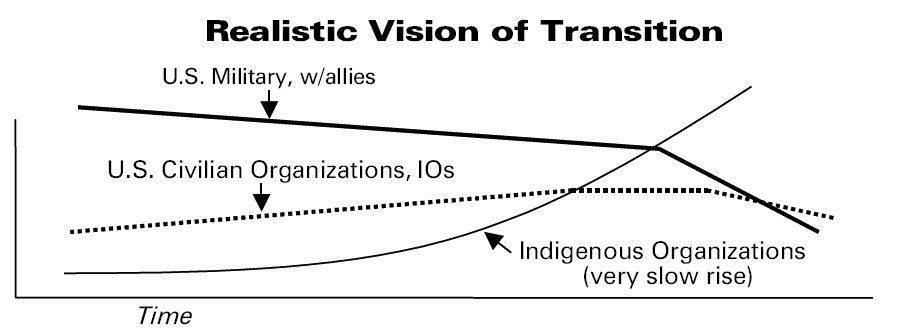

The US military - and the NATO armed forces as well - will in fact be asked to be able to if not formally manage then at least very substantially support whole conflict cycles. Or rather: They will be asked to deal extensively with the Phase IV things, as in Afghanistan, and not many civilian organizations will be there to help. Hence the PRTs.

But exactly this means that the military organizations should see an immediate self-centered interest in getting Shaping/CSE right. This not just conceptually, but also institutionally as an assured part of any two- or three-star's mindset. Shaping/CSE needs strategic attention. And a few bucks. But investing in systematic prevention planning and analysis capabilities will not be expensive.

Coming from a NATO country perspective the change in ambition for the Shaping/CSE JOC is therefore a disappointment. This kind of stuff will not emanate from NATO (SAC(T)). JFCOM needs to show intellectual leadership on this account. But, of course, I have no clue how the change played out - if there was involvement from elsewhere in the process once the scale of the ambition came clear.

And so, nonetheless, it will still be very interesting to the see the final text of the coming CS JOC.

It would be logical if Tom Barnett picked up on this, but he's busy writing the next book (and going to Springsteen concerts).

JFCOM: Shaping Ambition (Sort of) Implodes

(NB! There's a follow up to this post, here.)
The US Defense establishment does not want to do development any more. Or maybe a bit anyway. Those are the signals coming out from JFCOM concerning the - still - coming JOC on 'Shaping'.* Except for the the fact that it will no longer be called 'Shaping' but the much less ambitious 'Military Support to Cooperative Security'. In principle the ambition moves from managing fair statebuilding processes that actively helps popular inclusion into the state project (i.e. development) to security sector reform in various guises. That may be deplorable, as in a missed chance. As I wrote over a year ago:
The creation of African Command (AFRICOM) is accompanied by a the development of a new Joint Operating Concept (JOC) with potentially huge ramifications for the continent and for the whole development sector -- including the largest non-American partners, from the national development agencies (DfID, Danida, etc) over the EU and especially the UN to of course the 'host nations' in particularly Africa. This new JOC is called Shaping.
The initial JFCOM ambitions for Shaping were described as:
Scope: This JOC will focus on the actions a joint force commander might take in the context of unified action to advance US interests by:
  • building partnership capacity
  • influencing non-partners and potential adversaries
  • mitigating the underlying causes of conflict and extremism; and
  • setting the conditions that enable rapid action when military intervention is required
Proposed Solution: The Joint Force, as a part of a larger multinational and interagency effort, conducts continuous, anticipatory shaping operations that build partnerships with governmental, nongovernmental, regional and international organizations and reduce the drivers of conflict and instability in order to prevent or mitigate conflict or other crises and set the conditions for success in other operations—all aimed at a secure global environment favorable to US interests.
My ensuing conclusion was:
How do you '[mitigate] the underlying causes of conflict and extremism', and 'mitigate conflict and other crises'? Well, this is exactly the work of the aggregate development organisations: from the UKs PCRU and USAID plus international NGOs like the ICG to more long-term development organisations like UNDP. Mitigating underlying causes of conflict means addressing grievances before they turn into rebellion ... it means strengthening the local state so that it delivers to its citizens: from basic infrastructure, a working, stable and sustainable economy that provides jobs, rule of law and a decent political system.

The Pentagon will have their hands full -- and it is extremely important that they get the conceptual thinking right here. I hope the drafters will consult leading civilian development and political science experts and the extensive social science insights inside the CIA. (...)

On the civilian side, including the whole of the development universe: You better wake up and follow this development closely. The Pentagon has so much logistical and funding clout that if the Shaping concept does indeed get feet, then there will be some very real opportunities to move the development agenda forward.
And now, it seems, JFCOM has somewhat cold feet. Look at the JFCOM slide (ppt) below and then a quote from a testimony to the House Armed Services Committee (pdf) definition of the work on the Shaping (i.e. CS/CSE) JOC by Rear Admiral Dan Davenport:

- Draft Military Support to Cooperative Security, (CS JOC) focuses on how the Joint Force Commander contributes to fostering a security environment favorable to U.S. interests as well as establishing a base for effective crisis response. It addresses the full range of military support to a comprehensive, whole of government approach. “CS is defined as the set of continuous, long-term integrated, comprehensive actions among a broad spectrum of U.S. and international governmental and non-governmental partners that maintains or enhances stability, prevents or mitigates crises, and enables other operations when crises occur.”
As is visible the ambitions are curtailed a bit. Mostly, the military role will be either supporting or in the shape of defense reform.


Nevertheless, the notion of prevention and whole of government enabling still seems to smell a bit of converging the security and development agendas - so that the aggregate US foreign policy elements might get to play together in a kind of preventive COIN operation at the strategic level in given countries.

Managing the successful integration of the people into the state is the surest way to achieve stability. That is so because then the third element of the Clausewitzian trinity (state, people/nation, army) - the armed forces - will not be challenged from the inside but answer to a state that is legitimate because it deals with its citizens in a way that corresponds to their make up - in terms of both relative quantity (population mix) and quality (culture(s)).


The focus on interagency in the testimony is completely right. But I just hope that the NSPD44 does not become an excuse for not developing advanced strategic understanding of the anthropological and political scientific underpinnings of conflict prevention and state failure at the top of the US military. These insights are the most cost effective way for the US defense to deal with the conflicts that are not related to the big power and technological warfare paradigm, i.e. not least (for AFRICOM) in Africa.

NB! There's a follow up to this post, here.

________________
* = A JOC or Joint Operating Concept, is a kind of generalized Field Manual, a pure and joint doctrine. The hierarchy of the JFCOM concepts can be seen here. The former Shaping JOC is number 6 in the left column:

NB! There's a follow up to this post, here.

Tuesday, February 26, 2008

AFRICOM again

True to form we not only repeat the TicTacs but also the referrals to MountainRunner who's got the latest inside info on the new African Command. E.g.:

I attended USC's AFRICOM conference earlier this month and between panel discussions and offline conversations, I came away with a new appreciation (and hope) for the newest, and very different, command.

This is not like the other Combatant Commands (one DOD representative said they dropped "Combatant" from the title, but depending on where you look, all commands have that word or none of the commands include that adjective).

Also unlike other commands, this is "focused on prevention and not containment or fighting wars." This is, as one speaker continued, is a "risk-laden experiment" that is like an Ironman with multidisciplinary requirements and always different demands [...]. The goal, he continued, was to "keep combat troops off the continent for 50 years" because the consensus was, once troops landed on Africa, it would be extremely difficult to take them off.

Dracobs has been covering Africom of course from the early start - so check out the earlier posts, including those that project the Shaping JOC to be of central relevance for Africom. Shaping aims to do conflict prevention in the shape of grievance settlement, meaning that Pentagon has to do real political development policy.