Showing posts with label JFCOM. Show all posts

Friday, March 21, 2008

JFCOM: Shaping Ambition (Sort of) Implodes II

(This post is a follow up to yesterday's post, found here).

Why do I think that the apparent change in ambitions regarding the Shaping/CSE JOC is a missed opportunity?


First, a rehash of events. 1) Iraq: Invasion goes fine. Phase IV/Stabilization and Reconstruction plus handover does not. 2) December 2005, Gordon England signs DoD Directive 3000.05 which puts S&R on par with major combat operations inside US military. 3) The NSPD44 (National Security Presidential Directive) is issued. It hands ultimate responsibility for S&R/Phase IV to State. 4) State is not given substantial additional means and still has about half as many employees as Pentagon has lawyers, but does get the S/CRS: the Office of the COORDINATOR of reconstruction and stabilization. 5) S&R, which in the meantime has become SSTR gets its own JOC, which defines them as 'Military SUPPORT to Stabilization, Security, Transitioning and Reconstruction Ops'.

Why is this relevant for Shaping/CSE JOC question? Because, where Phase IV is the handover from military to civilian agencies (ours or host nation) and marks the beginning of the transition from war to peace (or regular politics) and from conflict to mere confrontation ... there Phase Zero is where prevention can happen; where initiatives are made in order to avert a conflict cycle. It is hence of crucial interest to the military. It furthermore contains many of the same civil-military dynamics and paradoxes as Phase IV. These are again the same dynamics that are in play within the COIN and interagency paradigm: How do you enable, plan for and execute a whole of government approach to issues that consist of a mix of political confrontation and possible conflict (often inside 'host nation')?

The problem is that when SSTR or Shaping/CSE doctrinally is defined as 'military support to', then the military is not the lead actor. And that makes it unlikely that the 3000.05 will get to function properly. Or that CSE will become a priority in Pentagon proper (notwithstanding the effect of the new presidency on the OSD).

There are therefore two reasons why the apparent change of ambition concerning Shaping/CSE is a missed opportunity: Mass and strategic attention. The two are related, in the sense of structured attention: If just a bit of Pentagon's structured attention gets diverted to political conflict prevention issues, then a lot will be gained. Pentagon has a budget of a size which means that a relatively small bit may equate a complete budget for other, related agencies. Only Pentagon has global logistical reach, extensive planning and analysis capability, and sufficient operational and executive mass.

The recurrent argument against dealing with the entire conflict cycle - as described in the Capstone document - is that, after all, war is about warfighting? Alas, not just. Given the means available in the Pentagon budget (again relative to State, CIA, USAid, NSC, etc) it will, in practice, be the military, which is left with the responsibility when things go awry. Just look at this chart from the great Crane/Terrill analysis from February 2003 (whole file here, pdf):
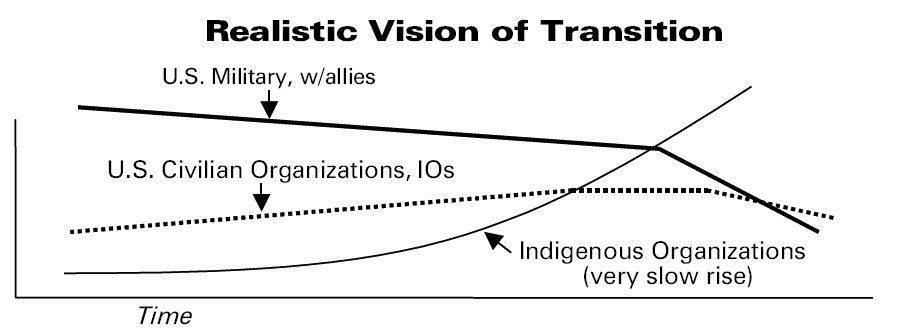

The US military - and the NATO armed forces as well - will in fact be asked to be able to if not formally manage then at least very substantially support whole conflict cycles. Or rather: They will be asked to deal extensively with the Phase IV things, as in Afghanistan, and not many civilian organizations will be there to help. Hence the PRTs.

But exactly this means that the military organizations should see an immediate self-centered interest in getting Shaping/CSE right. This not just conceptually, but also institutionally as an assured part of any two- or three-star's mindset. Shaping/CSE needs strategic attention. And a few bucks. But investing in systematic prevention planning and analysis capabilities will not be expensive.

Coming from a NATO country perspective the change in ambition for the Shaping/CSE JOC is therefore a disappointment. This kind of stuff will not emanate from NATO (SAC(T)). JFCOM needs to show intellectual leadership on this account. But, of course, I have no clue how the change played out - if there was involvement from elsewhere in the process once the scale of the ambition came clear.

And so, nonetheless, it will still be very interesting to the see the final text of the coming CS JOC.

It would be logical if Tom Barnett picked up on this, but he's busy writing the next book (and going to Springsteen concerts).

JFCOM: Shaping Ambition (Sort of) Implodes

(NB! There's a follow up to this post, here.)
The US Defense establishment does not want to do development any more. Or maybe a bit anyway. Those are the signals coming out from JFCOM concerning the - still - coming JOC on 'Shaping'.* Except for the the fact that it will no longer be called 'Shaping' but the much less ambitious 'Military Support to Cooperative Security'. In principle the ambition moves from managing fair statebuilding processes that actively helps popular inclusion into the state project (i.e. development) to security sector reform in various guises. That may be deplorable, as in a missed chance. As I wrote over a year ago:
The creation of African Command (AFRICOM) is accompanied by a the development of a new Joint Operating Concept (JOC) with potentially huge ramifications for the continent and for the whole development sector -- including the largest non-American partners, from the national development agencies (DfID, Danida, etc) over the EU and especially the UN to of course the 'host nations' in particularly Africa. This new JOC is called Shaping.
The initial JFCOM ambitions for Shaping were described as:
Scope: This JOC will focus on the actions a joint force commander might take in the context of unified action to advance US interests by:
  • building partnership capacity
  • influencing non-partners and potential adversaries
  • mitigating the underlying causes of conflict and extremism; and
  • setting the conditions that enable rapid action when military intervention is required
Proposed Solution: The Joint Force, as a part of a larger multinational and interagency effort, conducts continuous, anticipatory shaping operations that build partnerships with governmental, nongovernmental, regional and international organizations and reduce the drivers of conflict and instability in order to prevent or mitigate conflict or other crises and set the conditions for success in other operations—all aimed at a secure global environment favorable to US interests.
My ensuing conclusion was:
How do you '[mitigate] the underlying causes of conflict and extremism', and 'mitigate conflict and other crises'? Well, this is exactly the work of the aggregate development organisations: from the UKs PCRU and USAID plus international NGOs like the ICG to more long-term development organisations like UNDP. Mitigating underlying causes of conflict means addressing grievances before they turn into rebellion ... it means strengthening the local state so that it delivers to its citizens: from basic infrastructure, a working, stable and sustainable economy that provides jobs, rule of law and a decent political system.

The Pentagon will have their hands full -- and it is extremely important that they get the conceptual thinking right here. I hope the drafters will consult leading civilian development and political science experts and the extensive social science insights inside the CIA. (...)

On the civilian side, including the whole of the development universe: You better wake up and follow this development closely. The Pentagon has so much logistical and funding clout that if the Shaping concept does indeed get feet, then there will be some very real opportunities to move the development agenda forward.
And now, it seems, JFCOM has somewhat cold feet. Look at the JFCOM slide (ppt) below and then a quote from a testimony to the House Armed Services Committee (pdf) definition of the work on the Shaping (i.e. CS/CSE) JOC by Rear Admiral Dan Davenport:

- Draft Military Support to Cooperative Security, (CS JOC) focuses on how the Joint Force Commander contributes to fostering a security environment favorable to U.S. interests as well as establishing a base for effective crisis response. It addresses the full range of military support to a comprehensive, whole of government approach. “CS is defined as the set of continuous, long-term integrated, comprehensive actions among a broad spectrum of U.S. and international governmental and non-governmental partners that maintains or enhances stability, prevents or mitigates crises, and enables other operations when crises occur.”
As is visible the ambitions are curtailed a bit. Mostly, the military role will be either supporting or in the shape of defense reform.


Nevertheless, the notion of prevention and whole of government enabling still seems to smell a bit of converging the security and development agendas - so that the aggregate US foreign policy elements might get to play together in a kind of preventive COIN operation at the strategic level in given countries.

Managing the successful integration of the people into the state is the surest way to achieve stability. That is so because then the third element of the Clausewitzian trinity (state, people/nation, army) - the armed forces - will not be challenged from the inside but answer to a state that is legitimate because it deals with its citizens in a way that corresponds to their make up - in terms of both relative quantity (population mix) and quality (culture(s)).


The focus on interagency in the testimony is completely right. But I just hope that the NSPD44 does not become an excuse for not developing advanced strategic understanding of the anthropological and political scientific underpinnings of conflict prevention and state failure at the top of the US military. These insights are the most cost effective way for the US defense to deal with the conflicts that are not related to the big power and technological warfare paradigm, i.e. not least (for AFRICOM) in Africa.

NB! There's a follow up to this post, here.

________________
* = A JOC or Joint Operating Concept, is a kind of generalized Field Manual, a pure and joint doctrine. The hierarchy of the JFCOM concepts can be seen here. The former Shaping JOC is number 6 in the left column:

NB! There's a follow up to this post, here.

Wednesday, February 27, 2008

New Army Field Manual - Implementing Iraq

New Army Field Manual out: This time including SSTR. No time to look at it in detail now, defensetech has the preview here:
...the manual has finally taken the step of elevating stabilization operations to the level of offensive and defensive ops. (...) Chapter 3 is the most important chapter in the book; describing the Army's operational concept -- full spectrum operations. Full spectrum operations seize, retain, and exploit the initiative through combinations of four elements: offense, defense, and stability or civil support operations. Mission command is the preferred method of exercising battle command.
Basically, this is the practical implementation of the DoD Directive 3000.05 - and the result of necessities on the ground forcing top Army brass to accept the comprehensive or political COINesque approach to armed conflict championed by Petraeus and smart people at JFCOM.

Get the manual here at the Army site (direct link to pdf, 7,3 megs)

Speaking of JFCOM: Apparantly, a draft version of the Shaping JOC should be close to greenlighting mid March.

Tuesday, July 10, 2007

Civilian SSTR Planning: NSC or Private Sector Lead

There's a huge need for a civilian planning capacity related to SSTR and post-conflict situations (I have written about this before). This need may be the single most important element in the organizational transformation need to prepare ourselves for the next time around.

This blog often takes an American perspective - or looks primarily at American developments. This is because US leadership is paramount. Whatever happens elsewhere is likely to be to small to be consequential or effective. But this doesn't mean that other countries - notably the UK or e.g. Denmark - could not in theory either develop interesting concepts or organizational innovations which might either be of use or inspiration to the US institutions (as in e.g. the PCRU).

Establishing better integrated military-civilian planning is the only way to construct a strategically realistic "total cost of life" approach to future interventions. Such an approach should make clear e.g. the need for civilian (local or external) police forces. Of course, the Dobbins Handbook gives hints but we need more concrete planning.

Evidently, the Pentagon is not going to open their warplanning to civilians - not even the NSC. But it would be helpful if the civilian side could at least know that the Pentagon planning process had or will be reformed in accordance with the DoD Directive 3000.05 (the problem is here that the NSPD 44 formally gives State the lead, and the S/CRS does not have resources even remotely comparable to OSD, Pentagon itself or even JFCOM.

Of course, some of this planning stuff could be produced or at least introduced in generic form by the private and international public sector - here preferably the non-profit side - like e.g. a combination of UN people (from the UNDP plus the Peace-building Commission) and relevant think-tankers like the Dobbins people, and maybe concerted or hosted by the ICG.
But in purely US terms, the NSC could play such a role.

The NSC seems to be the only place where funds can be found for this kind of exercise (given substantive executive interest, i.e. will not happen until the next administration). But this means that now would be a good time to spread such and idea in order for it to be somewhere on the upcoming administrations' agendas. Richard Clarke's great "Against All Enemies" explains and exemplifies how an adept operator can help create leeway for interagency policy development inside the NSC. In fact, as he mentions explicitly, he was part of the process for creating POL-MIL plans starting with Haiti. So the nuts and bolts and precedence are there. As always it is more a matter of political will and focus than anything else.

Monday, May 07, 2007

The Most Unsexy Headline Ever: Planning Capabilities in the Inter-Agency Process

The USG inter-agency process* is dependent upon the planning capabilities of the Pentagon - and maybe it shouldn't be. Increasingly, the inter-agency process is the center of gravity for the United States' aggregate security capabilities (for simplifying reasons, let's stick here to the functional phases of conflict as conceptualized within US defense - phases zero to IV. Obviously, not all conflicts contain use of armed force). But only the US Department of Defense has extensive planning and business development sections working on generalized and concrete preparations for pre-conflict and post-conflict issues.

No-one doubts that the US rules phase III - major combat operations. But the US is not amassing the potential power it has for phases zero and IV. The latter refers to postconflict and the former to preconflict. To each of these belong at set of tasks that are more or less well-described and more or less well-understood. Post-conflict is a more well-described in terms of probable solutions and possibly better understood than pre-conflict. This is because post-conflict is more clearly a challenge for concrete organizations - ours, at least to begin with.

Post-conflict refers to both a complex organizational and logistic task (establishing country and government-wide administrative functioning organizations through military and civilian capabilities while/and handing them over to the host nation) and a strategic task namely identifying the wanted host national endstate, in fucntion of feasibility and ambitions (the choice is evidently shaped by political and anthropological both ramifications and limitations). To this effect, JFCOM has created the SSTR JOC which describes in general terms the challenges and is used as basis for doctrine development; Pentagon has issued the DoD Directive 3000.05, which sets SSTR Ops on par with major combat operations (i.e. the military has to be able to brak stuff efficiently and to hand over the pieces to subsequent civilian authority in accordance with the overall, wanted political endstate); and State has been given coordinate authority over phase IV so that the military in principle only has a supportive function - the chief of State's Office for the Coordinator of Reconstruction and Stabilization (S/CRS) is in charge of coordinating this particular element in the inter-agency process (not really sure how it/he formally ties in with the NSC which is in charge of the overall process).

Pre-conflict on the other hand is about identifying and addressing - ultimately managing - emerging conflicts so that they do not evolve into something we cannot live with for humanitarian or security reasons, or both. If we put on the USG glasses then, in principle, this challenge calls for both civilian and security (military and covert) means, because the challenge in itself has a political and anthropological character - it cannot be purely military. Much of the existing framework of international organizations and here especially the UN deals with pre-conflict. Development policy itself is a central piece in this puzzle. Conceiving of development policy as a means in to a pre-conflict management end is controversial but helpful.

Pre-conflict there has not recieved the same institutional attention as post-conflict. Only the JFCOM is developing a new Joint Operating Concept for 'Shaping' operations. The CINC at AFRICOM will be likely to get the responsibility for contingency planning like the other CINCs have. A number of these will be proper war plans. The majority will likely deal with evacuation, humanitarian assistance and especially FID, COIN and counterterrorism - foreign internal defense operations and (support to) counterinsurgency. But the most consequential work, if the AFRICOM commander gets it right, will be based on the conceptual work being done on pre-conflict issues.

There is an institutional trap here: the military traditionally is very strong in war planning. In its self-understanding the military exists to carry out major missions. These are represented in war and contingency plans. But the pre-conflict logic is more civilian, oriented towards day-to-day process of political subjects (but it is at the same time more general, strategic than a war plan case). The challenge for both JFCOM and AFRICOM will be to enhance the pre-conflict stuff to the same institutional importance as those threats that can be addressed through war planning.

The military develops and produces contingency planning and joint concepts at COCOM and JFCOM levels. No such equivalent exists within the civilian apparatus. The US military has some unique institutional strengths in planning and concept development, both in terms of talent and numbers, and in terms of formalization of process. The civilian side could learn a lot from these guys.

But there is an institutional imbalance here. Neither State Department or the NSC have ressources for strategic planning comparable to Pentagon's. Pentagon is 'only' responsible for developing plans and JOCs in support of the overall USG inter-agency process on pre- and post-conflict where the civilian agencies are in the lead. One solution is of course for e.g. the AFRICOM commander to involve or integrate civilian agencies very much up front in strategic planning and forecasting. But even if this is an understandable and pragmatic approach there is something lopsided about a process that will then hinge the institutitional setup of carrying out US foreign policy (State's domain) on the individual character of e.g. the AFRICOM commander. In the end, pre-conflict management can then be boiled down to whether the given commander 'gets' the political and anthropological stuff.

That seems like an unnecessarily contingent element.
Maybe State Department or the NSC should get into the conceptual development and planning work on their own account so that they get a better - more strictly institutionalized - chance of getting heard? That might also ensure, that the military winds up with less situations where they are formally in a supportive function while really having to do it all.


______________
* For the non-US reader: the 'inter-agency process' is the term describing the policy coordination going on inside US Government (USG). The National Security Council is the agency responsible for the process concerning national security matters.

Tuesday, March 20, 2007

Shaping Input: Africa's Horn in Foreign Affairs

The new issue of Foreign Affairs features a fine article on the conflicts – present and lurking – on Africa’s Horn, and the weaknesses of US policy ("Blowing the Horn", subscription required).

People at JFCOM currently working on the coming Shaping JOC are well advised to read John Prendergast and Colin Thomas-Jensen’s article. The challenges and solutions that they outline are basically what the JOC will have to address: learning full-scale diplomacy not in its diplomatic sense, but rather as a holistic problem-solving approach, which includes addressing grievances and issues over livelihoods.

The essential lessons of U.S. counterterrorism policy over the last five years – apparently unheeded by the Bush administration – is that in order for local Muslim populations to take the United States’ counterterrorism agenda seriously, the United States must take their state-building and power-sharing agenda seriously, too. Ironically, the strategy is already there on paper. In its 2002 National Security Strategy and elsewhere, the Bush administration has argued that failing states foster terrorism and has laid out a comprehensive approach to counterterrorism that involves promoting peace building, state reconstruction, and good governance. When it comes to the Greater African Horn, however, the Bush administration has simply not implemented its own policies. By relying on sporadic military strikes and continued support for autocrats without broader political planning, it has combined the worst elements of its current strategy in Iraq with the Cold War-era policy of cronyism. Conflict resolution and good governance are, in fact, the keys to countering terrorism in the Greater Horn of over the long term.

More on the Shaping JOC in this post – including the natural African focus of the JOC and here especially the CJFT-HOA. People who should also read their article include the CIA analysts involved not only with HOA related stuff, but also those working on projects similar to the Shaping JOC.

A final aside: Not surprisingly, the sharpest minds on the intricacies of policy development are no longer to be found in academia: they are more often at the best think tanks – and among them evidently the ICG where both authors reside.

Sunday, February 11, 2007

The Coming JFCOM 'Shaping' JOC: A Revolution In Development Policy?

The creation of African Command (AFRICOM) is accompanied by a the development of a new Joint Operating Concept (JOC) with potentially huge ramifications for the continent and for the whole development sector -- including the largest non-American partners, from the national development agencies (DfID, Danida, etc) over the EU and especially the UN to of course the 'host nations' in particularly Africa.

This new JOC is called Shaping. It is the logical prequel to the SSTR JOC -- published in its final version in December 06 after several years of preparation. The SSTR JOC deals with Stabilization, Security, Transition and Reconstruction Operations and is the new version of the old S&R. The inclusion of especially transitioning points to the growing understanding within the Pentagon system of the importance of founding the conceptual thinking about use of force on a properly clausewitzian basis: namely that military operations must always be thought of as an element in a larger political concept (not to say that MCOs do not have to function in a more clearcut independent way). The philosophical critique has been expressed particularly well by Antulio J. Echevarria, e.g. in this paper Toward An American Way of War. The SSTR JOC basically underpins all MOOTWs including counterinsurgency.

SSTR Ops are those contained inside what is known as Phase IV: what comes after Phase III or MCO (Major Combat Operations). As I wrote in a report on Transitioning (in Danish), back in summer '05, this distinction between the phases is breaking down: the subsequent publication of the DoD Directive 3000.05 which puts SSTR on par with MCO within the US military; the NSPD 44, which gives States responsibility for Phase IV; and the extensive work going on in all sectors of USG to improve inter-agency cooperation, planning and training (without much to show for it so far) shows how the breakdown is real but also causing a lot of headaches.

Where SSTR equals Phase IV, the Shaping JOC is then tasked with dealing with Phase 0. Phase 0 is about prevention of conflict, and should in this perspective be understood as an element in the Long War ... or the GWOT (global war on terrorism) as it apparently and weirdly still is called in Pentagon circles. This PPT file shows not only the timeline for the new Shaping JOC (version 1.0 is due in August '07) but also the basic aspirations of the JOC:
Military Problem: In the complex future environment, economic, demographic and societal stressors will lead to areas of instability. Future state and non-state adversaries, to include extremist ideologues, will use all means available to:
  • exploit this instability by undermining partnerships and further destabilizing weak governments,
  • deny or disrupt US influence or access, and
  • gain sanctuary in ungoverned, unstable, and remote areas
The future Joint Force Commander must be capable of working both unilaterally and closely with multinational, interagency and other partners to maintain or enhance stability, prevent or mitigate crises and set the conditions for access and responsive crisis intervention.

Scope: This JOC will focus on the actions a joint force commander might take in the context of unified action to advance US interests by:
  • building partnership capacity
  • influencing non-partners and potential adversaries
  • mitigating the underlying causes of conflict and extremism; and
  • setting the conditions that enable rapid action when military intervention is required
Proposed Solution: The Joint Force, as a part of a larger multinational and interagency effort, conducts continuous, anticipatory shaping operations that build partnerships with governmental, nongovernmental, regional and international organizations and reduce the drivers of conflict and instability in order to prevent or mitigate conflict or other crises and set the conditions for success in other operations—all aimed at a secure global environment favorable to US interests.
How do you '[mitigate] the underlying causes of conflict and extremism', and 'mitigate conflict and other crises'? Well, this is exactly the work of the aggregate development organisations: from the UKs PCRU and USAID plus international NGOs like the ICG to more long-term development organisations like UNDP. Mitigating underlying causes of conflict means addressing grievances before they turn into rebellion ... it means strengthening the local state so that it delivers to its citizens: from basic infrastructure, a working, stable and sustainable economy that provides jobs, rule of law and a decent political system.

The Pentagon will have their hands full -- and it is extremely important that they get the conceptual thinking right here. I hope the drafters will consult leading civilian development and political science experts and the extensive social science insights inside the CIA.

As a consequence of the NSPD 44, both the SSTR and the Shaping JOC are entitled "Military Support to..." but the Shaping PPT nevertheless underlines the probably necessity for the military to be able to deal unilaterally with the issue, i.e. have the capabilities to carry out these things without the interagency process. This is true also for SSTR: in many situations the military is the only organization present, as is visible in e.g. Afghanistan.

What are the ramifications? On the Pentagon side, the answer depends not only on the thinking to be done, but also on the implementation. The interesting thing here is that AFRICOM will offer the Shaping JOC a natural home (EUCOM shares the lead on the JOC development with JFCOM: will probably be transferred to AFRICOM?) -- it will not have to battle (a losing) struggle to get influence within the other COCOMs. Its reception within SOCOM is, however, very important.
As Tom Barnett has noted, the existing CJTF-HOA will probably form the basis for AFRICOM even if it is placed in Stuttgart to begin with. Stuttgart is also the home of a SOCOM force (10th Special Forces Group, 1st Battalion). This may be a coincidence but it is probably not: The Long War's shaping missions will not solely be about development-like issues but will also include sharp-end elements, which is where the special forces come in handy as they excell in these more surgical operations. AFRICOM's tasks may be very political in nature but they will include very military means.

On the civilian side, including the whole of the development universe: You better wake up and follow this development closely. The Pentagon has so much logistical and funding clout that if the Shaping concept does indeed get feet, then there will be some very real opportunities to move the development agenda forward. My guess is, however, that most likely the development crowd will shy away from cooperation with the Pentagon. This is especially the case for the European development agencies.

Finally, there is NATO: This is stuff which should interest the CIMIC Centre of Excellence, but also people at higher echelons: anyone in the NATO militaries dealing with strategic planning.

This is a thing to be followed closely!

____________________________________________________
EDIT: This old post gets a lot of readers. Please do not miss the later posts on Shaping, either by clicking here (and show all posts on shaping); or by going to these two posts, which further follow and evaluate Shaping/CSE:

Tuesday, February 06, 2007

African Command Comes To Life

African Command will be a reality: DEFSEC Gates' statements at today's Senate hearing revealed as much (even if his prepared statement stuck to mostly explaining the rationale behind the Defense budget, here, pdf).

The essential characteristic of the new African Command is the essentially political caretaker role that it is designated to have -- as opposed to a combat oriented command:
"The president has decided to stand up a new unified combatant command, Africa Command, to oversee security, cooperation, building partnership capability, defense support to nonmilitary missions, and, if directed, military operations on the African continent," Gates said. This command will enable us to have a more effective and integrated approach than the current arrangement of dividing Africa between Central Command and European Command, an outdated arrangement left over from the Cold War."
Can't wait to see the new Joint Forces Command Shaping concept: this is what AfriCom will do.

Other, longer posts on African Command can be found here.