Sunday, March 04, 2007

Fun Invasion, Europe Still at Peace

Fun invasions are few and far between. But the Swiss seem to have come up with one:
Swiss Accidentally Invade Liechtenstein
ZURICH, Switzerland (AP) -- What began as a routine training exercise almost ended in an embarrassing diplomatic incident after a company of Swiss soldiers got lost at night and marched into neighboring Liechtenstein. According to Swiss daily Blick, the 170 infantry soldiers wandered just over a mile across an unmarked border into the tiny principality early Thursday before realizing their mistake and turning back. A spokesman for the Swiss army confirmed the story but said that there were unlikely to be any serious repercussions for the mistaken invasion.
From AP. Not bad going for a landlocked country with (kind of) a Navy. But apparently, the Swiss do have thing with politeness - as Orson Welles put it in The Third Man:
"In Italy for thirty years under the Borgias they had warfare, terror, murder, bloodshed - but they produced Michelangelo, Leonardo da Vinci, and the Renaissance. In Switzerland they had brotherly love, 500 years of democracy and peace, and what did that produce? The cuckoo clock. So long, Holly."

Friday, March 02, 2007

Black Hawk Down Documentary On YouTube

Stumbled upon this YouTube-find: A long high quality documentary on the Black Hawk Down incident narrated by Mark Bowden himself. It's in several chapters - all named "The truth of Black Hawk Down (part x)". Not sure about the copyright situation.


Link to first part (the one above: links to subsequent parts are found here, under 'related').

Sunday, February 11, 2007

The Coming JFCOM 'Shaping' JOC: A Revolution In Development Policy?

The creation of African Command (AFRICOM) is accompanied by a the development of a new Joint Operating Concept (JOC) with potentially huge ramifications for the continent and for the whole development sector -- including the largest non-American partners, from the national development agencies (DfID, Danida, etc) over the EU and especially the UN to of course the 'host nations' in particularly Africa.

This new JOC is called Shaping. It is the logical prequel to the SSTR JOC -- published in its final version in December 06 after several years of preparation. The SSTR JOC deals with Stabilization, Security, Transition and Reconstruction Operations and is the new version of the old S&R. The inclusion of especially transitioning points to the growing understanding within the Pentagon system of the importance of founding the conceptual thinking about use of force on a properly clausewitzian basis: namely that military operations must always be thought of as an element in a larger political concept (not to say that MCOs do not have to function in a more clearcut independent way). The philosophical critique has been expressed particularly well by Antulio J. Echevarria, e.g. in this paper Toward An American Way of War. The SSTR JOC basically underpins all MOOTWs including counterinsurgency.

SSTR Ops are those contained inside what is known as Phase IV: what comes after Phase III or MCO (Major Combat Operations). As I wrote in a report on Transitioning (in Danish), back in summer '05, this distinction between the phases is breaking down: the subsequent publication of the DoD Directive 3000.05 which puts SSTR on par with MCO within the US military; the NSPD 44, which gives States responsibility for Phase IV; and the extensive work going on in all sectors of USG to improve inter-agency cooperation, planning and training (without much to show for it so far) shows how the breakdown is real but also causing a lot of headaches.

Where SSTR equals Phase IV, the Shaping JOC is then tasked with dealing with Phase 0. Phase 0 is about prevention of conflict, and should in this perspective be understood as an element in the Long War ... or the GWOT (global war on terrorism) as it apparently and weirdly still is called in Pentagon circles. This PPT file shows not only the timeline for the new Shaping JOC (version 1.0 is due in August '07) but also the basic aspirations of the JOC:
Military Problem: In the complex future environment, economic, demographic and societal stressors will lead to areas of instability. Future state and non-state adversaries, to include extremist ideologues, will use all means available to:
  • exploit this instability by undermining partnerships and further destabilizing weak governments,
  • deny or disrupt US influence or access, and
  • gain sanctuary in ungoverned, unstable, and remote areas
The future Joint Force Commander must be capable of working both unilaterally and closely with multinational, interagency and other partners to maintain or enhance stability, prevent or mitigate crises and set the conditions for access and responsive crisis intervention.

Scope: This JOC will focus on the actions a joint force commander might take in the context of unified action to advance US interests by:
  • building partnership capacity
  • influencing non-partners and potential adversaries
  • mitigating the underlying causes of conflict and extremism; and
  • setting the conditions that enable rapid action when military intervention is required
Proposed Solution: The Joint Force, as a part of a larger multinational and interagency effort, conducts continuous, anticipatory shaping operations that build partnerships with governmental, nongovernmental, regional and international organizations and reduce the drivers of conflict and instability in order to prevent or mitigate conflict or other crises and set the conditions for success in other operations—all aimed at a secure global environment favorable to US interests.
How do you '[mitigate] the underlying causes of conflict and extremism', and 'mitigate conflict and other crises'? Well, this is exactly the work of the aggregate development organisations: from the UKs PCRU and USAID plus international NGOs like the ICG to more long-term development organisations like UNDP. Mitigating underlying causes of conflict means addressing grievances before they turn into rebellion ... it means strengthening the local state so that it delivers to its citizens: from basic infrastructure, a working, stable and sustainable economy that provides jobs, rule of law and a decent political system.

The Pentagon will have their hands full -- and it is extremely important that they get the conceptual thinking right here. I hope the drafters will consult leading civilian development and political science experts and the extensive social science insights inside the CIA.

As a consequence of the NSPD 44, both the SSTR and the Shaping JOC are entitled "Military Support to..." but the Shaping PPT nevertheless underlines the probably necessity for the military to be able to deal unilaterally with the issue, i.e. have the capabilities to carry out these things without the interagency process. This is true also for SSTR: in many situations the military is the only organization present, as is visible in e.g. Afghanistan.

What are the ramifications? On the Pentagon side, the answer depends not only on the thinking to be done, but also on the implementation. The interesting thing here is that AFRICOM will offer the Shaping JOC a natural home (EUCOM shares the lead on the JOC development with JFCOM: will probably be transferred to AFRICOM?) -- it will not have to battle (a losing) struggle to get influence within the other COCOMs. Its reception within SOCOM is, however, very important.
As Tom Barnett has noted, the existing CJTF-HOA will probably form the basis for AFRICOM even if it is placed in Stuttgart to begin with. Stuttgart is also the home of a SOCOM force (10th Special Forces Group, 1st Battalion). This may be a coincidence but it is probably not: The Long War's shaping missions will not solely be about development-like issues but will also include sharp-end elements, which is where the special forces come in handy as they excell in these more surgical operations. AFRICOM's tasks may be very political in nature but they will include very military means.

On the civilian side, including the whole of the development universe: You better wake up and follow this development closely. The Pentagon has so much logistical and funding clout that if the Shaping concept does indeed get feet, then there will be some very real opportunities to move the development agenda forward. My guess is, however, that most likely the development crowd will shy away from cooperation with the Pentagon. This is especially the case for the European development agencies.

Finally, there is NATO: This is stuff which should interest the CIMIC Centre of Excellence, but also people at higher echelons: anyone in the NATO militaries dealing with strategic planning.

This is a thing to be followed closely!

____________________________________________________
EDIT: This old post gets a lot of readers. Please do not miss the later posts on Shaping, either by clicking here (and show all posts on shaping); or by going to these two posts, which further follow and evaluate Shaping/CSE:

Tuesday, February 06, 2007

Blogging Hiatus

Apologies to regular readers: As has been the case since new years I will only blog intermittently for the coming month or so. Hope to be back in more extensive shape after that. And thanks for checking in!

African Command Comes To Life

African Command will be a reality: DEFSEC Gates' statements at today's Senate hearing revealed as much (even if his prepared statement stuck to mostly explaining the rationale behind the Defense budget, here, pdf).

The essential characteristic of the new African Command is the essentially political caretaker role that it is designated to have -- as opposed to a combat oriented command:
"The president has decided to stand up a new unified combatant command, Africa Command, to oversee security, cooperation, building partnership capability, defense support to nonmilitary missions, and, if directed, military operations on the African continent," Gates said. This command will enable us to have a more effective and integrated approach than the current arrangement of dividing Africa between Central Command and European Command, an outdated arrangement left over from the Cold War."
Can't wait to see the new Joint Forces Command Shaping concept: this is what AfriCom will do.

Other, longer posts on African Command can be found here.

Wednesday, January 17, 2007

In Spite of Wailing World, Babel Takes Golden Globe

On a blogging hiatus -- but this piece of info ... man! Babel won the Golden Globe for Best Picture. Maybe Babel is becoming a pet obsession, but oh do I hope for any other film to twart Babel's daft little Oscar hopes. Of course, with my kind of luck -- or perhaps: penchant for criticizing the winners like I did with Crash -- it'll probably just run away with that prize too. The only consolation? It only took one of out the seven GG's it was nominated for.

Monday, January 08, 2007

Tic Tacs #3: Long War By Petraeus, Harrison and the Air Force

Introductory portrait of General Petraeus, the American Commander in Iraq, in the Washington Post. Very interesting -- my European readers should read this, not least because it seems that the self-evident truth for any US government watcher that administrative and doctrinal turf wars matter and make the Goliath seem less monolithic than it is is often overlooked -- wilfully? -- by those who criticize it easily. Never explain by malevolence that which can be explained by incompetence -- or a learning curve.

Oh, and if you haven't seen it, this great piece by Harrison, which came out before Christmas, on the role of culture in nation-building. Of course this was always for the long haul: we are in the business of shrinking the Gap, and the agenda is exactly about formatting minds with each new generation. 200 years more until the End of History.

The generational aspect pops up here in this old December intro to the Long War through Air Force (!) Brig. Gen. Schissler who's deputy director for the GWOT in Joint Staff (do they actually still call it that?).

Then a clearly disturbed story from the LA Times about the surge plan being aprt of renewed neocon cabale. Come on: they cannot both be responsible for screwing up the post-conflict part and for wanting and having wanted more troops all the time. But maybe now is the time to listen -- not necessarily for the neocon rationales, but to the extent that they concord with military sagesse. Either way, yelling at the neocons is exactly what we don't need when important decisions are being presented to the public (cf. the note on seeing a monolith only above).

Some things are moving already on the new Iraqi strategy: dealing with unemployment should have been focus area very early on ... instead of adding to it. According to the AP some projects have already been launched, making a total of 11.000 jobs supposedly supporting almost 150.000 Iraqis.

Finally, more details are emerging on the new African Command -- it will exclude Egypt while CJTF in the Horn of Africa will stay with Centcom for another 18 months. All from the Christian Science Monitor.

And, as usual, do go read MountainRunner, this time for his 11 Steps To Success in Iraq.

Thursday, January 04, 2007

Bildt's Myopic European Vision for Sweden

Former EU and UN Balkan envoy and Swedish PM Carl Bildt was named Minister of Foreign Affairs in Sweden back in early October. Bildt is perhaps the Scandinavian politician with the most international experience -- and he is a smart man. As a MFA he held a speech before christmas outlining grand traits of Swedish foreign policy, which is worth the read: comprehensive and straightforward reasoning.

One clear weakness though, as so often with those who think primarily within the EU paradigm: The role of security policy looks strangely downplayed and the policy recipes are even more blueeyed. Basically, the way forward for Carl Bildt is a Europeanization of Swedish foreign policy.

Despite my tremendous optimism on the power and opportunities of globalisation, I am one of those who regard the strategic perspectives of the next few decades with deep concern. And who are convinced that only a more intensive strategic discussion on the challenges we are facing will be able to lead to policies that move us forward.

Basically, what is important is to safeguard and further develop all the opportunities of globalisation for an increasingly open and better world – but to do this in full awareness of the strength of the forces that, if they succeed in growing stronger, risk throwing everything into disarray.

No global era of liberation and new opportunities has lasted for ever. War and confrontation have not been written out of history.

And these crucial challenges are to be found in areas that, in terms of today’s distances, lie close to our Europe.

An attempt at predicting the future in 2025, recently published by the EU Institute for Security Studies – The New Global Puzzle: What World for the EU in 2025? – stated laconically that “the political, economic and security outlook at the borders of the Union is likely to have deteriorated considerably” before then, and warned of the possibility of “a systematic breakdown of the Middle East.”

The trends are not difficult to see. Authoritarian states that lack legitimacy. Stagnating economies and rapidly growing populations. And at the same time, the increased role of religion in politics as well –which is not limited to the Islamic world alone. (...)

In our globalised world, both security and insecurity are also globalised.

And as we now look ahead, it is the developments in the forecourts of Europe – over towards Hindu Kush, down towards the Strait of Hormuz, the Horn of Africa and the cultural dividing lines of the southern Sahara – that represent the most serious threats we must be able to face in order to have faith in the future potential of globalisation.

If we want to meet these challenges, and secure the better world that will so clearly be possible, there is no alternative to a stronger Europe – with the examples it sets, with its initiatives and as a partner in cooperation with others.

And that conclusion is further strengthened by all the other new challenges that now confront us.

It is no longer possible for anyone to ignore the substantially increased importance that global environmental issues will have. Can we protect maritime resources from depletion so that we do not create risks for future generations? And the challenges involved in the significantly increased demand for energy can hardly be underestimated. The work to meet the new risks posed by new infections and diseases, in a time when viruses can also quickly fly first class between the cities of the world, will also demand a new level of international cooperation.

Being Minister for Foreign Affairs in Sweden today is not the same as it was yesterday.

We are living at the beginning of a major paradigm shift of our own. We are in the midst of a new phase of accelerating globalisation. We see the darkness at the edge of Europe’s strategic horizon. And we see how states are weaker and more tentative when confronted with all these new developments.

Naturally, national foreign policy still has a role to play. We have a role in developing cooperation in the Baltic Sea region and northern Europe, which will become ever more important. We must safeguard our national interests even in an age of internationalism.

But even so, these are not the crucial tasks.

The crucial tasks lie in strengthening European cooperation which can make us, together, the force in the service of peace, freedom and reconciliation that the world will be in ever more desperate need of.

They lie in safeguarding the ideas of the open society, open economies and the open world against those forces that want to turn back the clock.

And they lie in building better networks for international cooperation that can provide globalisation with new opportunities. To a large extent, this is of course a matter of the United Nations – continuing to build on the five lessons that Kofi Annan presented in his recent speech.

Our society has increasingly become both more Europeanised and more globalised.

Our prosperity has always been based on our participation in European and global economic integration – but even in these respects, we see how developments are accelerating.

The very limited mentioning of the transatlantic relationship makes this very hard to accept as a bone fide foreign policy for a small Western country. But thought provoking that Bildt actually feels this way: very top people can also be fundamentally wrong.

Wednesday, January 03, 2007

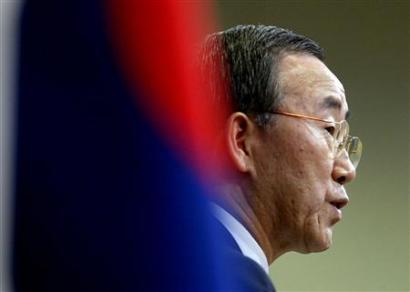
Sovereignty Is Back: UNSG Ban Ends Paradigm of State Accountability

According to AP, new UNSG Ban Ki Moon makes a poignant start in his new job -- by changing the basic direction of the UN from "pro-state accountability" to "anti-interference in domestic affairs":
New U.N. Secretary-General Ban Ki-moon ran into trouble on his first day of work Tuesday over Saddam Hussein's execution when he failed to state the United Nations' opposition to the death penalty and said capital punishment should be a decision of individual countries. The U.N. has an official stance opposing capital punishment and Ban's predecessor Kofi Annan reiterated it frequently. The top U.N. envoy in Iraq, Ashraf Qazi, restated it again on Saturday after the former Iraqi dictator was hanged.

Ban, however, took a different approach, never mentioning the U.N. ban on the death penalty in all its international tribunals, and the right to life enshrined in the U.N.'s Universal Declaration of Human Rights. "Saddam Hussein was responsible for committing heinous crimes and unspeakable atrocities against Iraqi people and we should never forget victims of his crime," Ban said in response to a reporter's question about Saddam's execution Saturday for crimes against humanity. "The issue of capital punishment is for each and every member state to decide."

His ambiguous answer put a question mark over the U.N.'s stance on the death penalty. It also gave the new chief an early taste of how tricky global issues are, and how every word can make a difference. Michele Montas, Ban's new spokeswoman, insisted there was no change in U.N. policy in what she described as "his own nuance" on the death penalty. "The U.N. policy still remains that the organization is not for capital punishment," she said. "However, the way the law is applied in different countries, he left it open to those different countries."

Can we just put this remark aside as Ban's "personal nuance"? Probably not. First of all, there is no such thing as a personal pov of a leader in this kind of position. Danish PM Anders Fogh tried it a couple of years back, but there can be no discrepancy between the PM and the privcate person's attitudes and beliefs -- not in the public sphere at least.

Why is Ban's stance on the death penalty so significant? Because the reason he uses to justify the absence of condemnation of the death penalty is something that goes fundamentally against the strong UN intervention paradigm of the 1990s.

The paradigm consisted -- consists -- in the same kind of accountability principle which is at the heart of the US National Security Strategy: states sovereignty i, must be, curtailed by their responsibility vis-à-vis their own citizens. If they fail to treat their citizens according to a set of lowest common denominators -- human rights factored with a dose of pragmatic reality -- they can be held responsible to "world society". What "world society" means in practice is then the stone of contention: should it mean the UN Assembly, The UNSC, the West or the US or what? Of course an argument can be made that the countries that do fullfil these criteria are already identified: its the OECD, and that they have a certain moral capital to spend here. In this sense, the UN intervention paradigm, which has been perceived as very leftist in some policy circuitws in the States is inherently close to much of the moral part of the neocon paradigm -- they sharre rationales, but differ just on who gets to decide. Kofi Annan spoke out on several occasions for this paradigm (from the UN perspective) -- notably in a 1999 Economist "by invitation" oped.

Against this paradigm stands another, the non-intervention or non-interference paradigm supported notably by all the dictatorships of the world and many developing countries, including India and China. It is best expressed in the principles of
panchsheel, ironed out in common by India and China, are also the principles behind the Cold War non-aligned movement. As explained in this post, the panchsheel are also at the heart of China's African strategy and concrete policies. Arguably, today's basic grand strategy battle is between the human rights, pro-interference agenda -- and that of the right to oppress and mistreat your citizens.

Ban now visibly opposes the former concept, even on a seemingly small subject. I do not believe this to be a gaffe, as hinted in the AP article. It is a symbolical message from Ban to his supporters: the UN shall henceforth not be used to circumvent national sovereignty -- "Go do what you please, we won't mind." The momentum of freedom is indeed waning.


Sunday, December 31, 2006

Saddam: Sign That Dirty Shiite Option in Play?

Abu Ardvaark has a disturbing analysis of the ramifications and details of the Saddam Hussein execution: the Shiite option may actually be on the table as a strategy in Iraq. This would entail siding with the Shia in order to crush the Sunni insurgency.

As mentioned earlier in the "Dirty Shiite Option" the crucial element to be on the lookout for is what the intended end-state is -- simply siding with Shia is going to come back and bite us eventually. We have to deliver some kind of brokered compromise. Abu Aardvark has done the thinking, and Eric Umansky backs it up with details from the exeution (hat tip Defense Tech).

Aside from the Iraqi perspective of the execution, WashPost also has a good article on the "
The first great Shakespearean death scene of the YouTube generation" with some obvious ramifications for the information side conduct of counterinsurgency in the Long War:
For as long as he was alive, Hussein was useful for an important American argument about the war. He was a bad guy; we captured him; he would face justice. This miniature narrative, contained within the broader one of a war gone terribly wrong, is losing its force. And with Hussein dead it will likely become almost entirely inert. Another video clip, easily found on the Web, showed Hussein dead, wrapped in a white cloth, with his face clearly visible. The camera lingered over the image for a strangely long time, as if to say, yes, he's still dead.

Saddam Hussein Is Still Dead is not a rallying cry. But the images of his execution and his body seem to point to a new era in the way images are used politically, what might be called a post-propaganda era. So many images that were supposed to have such profound impact on public perception -- the now infamous "Mission Accomplished" photo op or Abu Musab al-Zarqawi's bloody head tastefully framed for the cameras -- have failed to connect with the reality of either public opinion, or the facts on the ground. This image means progress, we're told, but there isn't any progress. This image is a final chapter, but the blood still flows. For a public media campaign to work, at least some of the politically calculated captions placed on images must, in the end, turn out to be true.

The current administration has attempted to construct a classic media argument in support of the war at a time when "the media" are dissolving and re-forming into something new, something in which the images we wish to see are more important than the images we are forced to see. Even before the execution video arrived, television people were publicly clucking about what they would or wouldn't show. It will be tasteful, they assured us. But their efforts at gatekeeping are now almost entirely irrelevant. The public will find exactly as much of the death of Hussein as it wants, and people will watch for as long as it holds any novelty or fascination.

(Barnett on) New Chinese Defense White Paper

New Chinese defense white paper out as described in this WashPost article:

The Chinese views on regional security, articulated in a government white paper on national defense, provided a rare glimpse into the strategic assessments that underlie decisions and priorities of the secretive Chinese military and the Communist Party's policymaking Central Military Commission. In part, the paper was designed as a response to repeated complaints from the Bush administration that China has not explained the rationale behind its long-term military improvement program. China's announced military budget has risen about 10 percent a year recently, reaching $35.4 billion in 2006, and Pentagon specialists estimate that also counting equipment expenditures would more than double it.

Along with Taiwan's pursuit of independence, the government pointed out as particular security challenges North Korea's missile tests last summer and its maiden nuclear test in October, which undermined Chinese-led diplomatic efforts to create a nuclear-free Korean Peninsula. The most recent round of nuclear negotiations took place last week and ended in stalemate, creating doubts about the utility of continuing the three-year-old six-nation talks. In listing Chinese concerns, the white paper also cited a U.S.-Japanese effort to build a regional missile defense shield based on U.S. ships equipped with the Aegis radar system and a U.S.-Japanese missile now being developed. The joint defense system, portrayed as protection against a North Korean attack, has been criticized by Chinese officials and commentators because it also could blunt China's missile threat in the event of U.S.-Chinese hostilities over Taiwan.

Chinese officials have expressed concern that Taiwan could eventually be integrated into the U.S.-Japanese system, providing a counterweight to China's increasing missile threat against the self-ruled island. That fear was not explicitly conveyed in the white paper, but Japan's growing willingness to assert itself militarily was cited as a strategic concern for military planners in Beijing. "America and Japan are strengthening their military alliance in pursuit of operational integration, and Japan seeks to modify its peace constitution and exercise collective self-defense," the paper said. "North Korea launched missiles and had a nuclear test. The situation in the Korean Peninsula and northeast Asia is getting more and more complicated and serious."

The paper said China's military improvements are part of the country's overall modernization and economic expansion. The effort will continue apace, it added, seeking to "lay a solid foundation" by 2010, make "major progress" by 2020 and "reach the strategic goal of building informationized armed forces and being capable of winning informationized wars by the mid-21st century." Moving from infantry to high-tech naval and aerial warfare has been a major goal of China's military modernization. It has entailed the shedding of thousands of untrained foot soldiers and a concerted effort to replace them with trained technicians able to function in the world of computerized weaponry.

At the face of things then classic security dilemma situation. Tom Barnett has covered the article already of course:

So what is China guilty of in this last explanation of its vaunted defense build-up?

As a rising economic power they're doing to their military the same thing they've been doing to their economy for years now: swapping out cheap labor (here, ground troops) for high-tech capital (mostly air and naval, aping their model, otherwise known as the U.S. military). Why does the PLA ape the Pentagon? Who else should they logically ape?

And here are the provocative rationales offered by Hu Jintao for China's build-up:

1) danger on the Korean peninsula (hmm, that one's hard to critique);

2) rising U.S.-Japanese military cooperation (given the state of Sino-Japanese relations, that seems fairly plausible, does it not?)

3) rising provocations re: independence from Taiwan (that's really BS, but a standby for the Chinese).

China continues to use Taiwan as a national diversion, with the Party leadership making that the great excuse for a build-up that logically arises from China's rising. Yes, the obsession is real, and it's mind-boggling with the PLA. I have sat in conversations with their military strategists and planners and listened to nonsense after nonsense on this issue. You'd think the whole frickin' universe revolved around this all-important scenario, when--truth be told--this scenarios matters only to military acquisition planners in both Beijing and Washington. Why? Frankly, it's all we have left and for the Chinese, it's a nice cover for what I believe to be the long-term rationale truly at work: China's growing fears over its rising energy dependence, which within years will vastly outweigh ours.

But my God! What kind of nation builds a big military to protect its access to energy around the planet?

Well, actually, that would be us by a huge margin. (...)

All this mirror imaging by China's strategic thinkers, whether it's on Taiwan or energy security, that's got to be something just to confuse us. Surely they cannot be so unimaginative simply to ape our moves, building a naval and air force whose primary design is to prevent our ability to threaten their ability to threaten Taiwan's ability to threaten independence? And beyond that simply to guard sea lines of communication? Surely the Chinese strategic vision is not that narrow, that myopic?

Why the hell not? That's basically our Big War rationale. With China, they're aping #1. But what exactly is our excuse when Marines and Army are dying every day in this Long War we've declared? Why is the Pentagon so intent on having a war with the country that inevitably becomes our biggest economic partner?

I'm not overstating. There are many in the military and especially the Air Force and Navy that just gotta have their conflict with China. Otherwise these guys must contemplate evolutions of their forces that they do not care to contemplate.

Too many Pentagon planners want to make the environment match the force, not the other way around. They'll tell you China spies on us and tries to steal our secrets, constantly trying to make their force more like ours. They'll tell you the big future threat we face is the loss of Taiwan. They simply don't want the war we've got, and if left to their own devices, will continue to build a force that's unprepared for that war--getting our people killed in the process.

Friday, December 29, 2006

Meta-Dabble on Sage, Specialization

Following Svenpundit's funny metapost on "Alternate Universe Blogging" I'll allow myself a meta-dabble too, albeit -- as it where -- in a tediously Scandinavian manner.

I finally settled on a feed-reader after trying out a few and looking at a few more. Sage it is. Integrates automatically with Firefox, and the two basic functionalities -- update feeds and find feeds on open tab -- work easily. The only thing I kind of miss is the possibility to have all new feeds aggregated on the same page -- a bit like Google News.

So reading the blogs got a lot easier -- but also troublesome. For a fox (as opposed to hedgehog) incarnate, there's just too much to take in ... or rather: too little time. Moreover, the hedgehog-like call for specialization as a comparative advantage in the bloguniverse is even more pressing when the feeds are so readily available. But hey, I asked for it.

A final note: All of a sudden it strikes me, that since I can read anyone's posts without going to their URLs my visit will probably not be detected by their SiteMeter function? Or are these hits still accounted for?

Wednesday, December 27, 2006

What Katrina Says About Counterinsurgency

Central parts of what has gone wrong in Iraq and Afghanistan are only partially tied to Big Issues like military strategy and tactics. Rather, these stem from a not very debated part of security and military studies: the introduction of (perceived) modern management and administration techniques such as outsourcing -- executed in a peculiarly blueeyed way that is glaringly incompetent. This story from CNN -- on the lack of controls on reconstructing funding spent on Katrina story -- confirms the pattern:
The tally for Hurricane Katrina waste could top $2 billion next year because half of the lucrative government contracts valued at $500,000 or greater for cleanup work are being awarded with little competition. Federal investigators have already determined the Bush administration squandered $1 billion on fraudulent disaster aid to individuals after the 2005 storm. Now they are shifting their attention to the multimillion dollar contracts to politically connected firms that critics have long said are a prime area for abuse.

In January, investigators will release the first of several audits examining more than $12 billion in Katrina contracts. The charges range from political favoritism to limited opportunities for small and minority-owned firms, which initially got only 1.5 percent of the total work. "Based on their track record, it wouldn't surprise me if we saw another billion more in waste," said Clark Kent Ervin, the Homeland Security Department's inspector general from 2003-2004. "I don't think sufficient progress has been made."

The story about the incompetent handling of the outsourcing of police training in Afghanistan a) looks a lot like the one on Katrina here, and b) might explain a lot about the current situation (mentioned in this post).

Evidently, any kind of public outsourcing should follow basic rules of accountability, transparency and oversight. And more evidently, these are especially called for when the outsourcing deals with issues of national security interest. In the case of Federal outsourcing these exist (OMB Circular A–76, 2003, pdf). Enabling more federal outsourcing has been a focus area for the Bush Administration, including the Army (the Army's implementation of the OMB rules is called Army Regulation 5-20). Whether these revised rules are too lax I don't know: all that is visible from here is the practical context and fallout, e.g. as in this 2003 news item:
Officials want to turn over to the private sector those jobs determined not to be central to the Army’s national defense mission. The method generally followed is to allow defense contractors to compete with Army employees to determine who can best perform the job at the lowest cost, a process that requires a comprehensive economic analysis. The Army’s plan is in keeping with last year’s White House directive that agencies increase the amount of work deemed not "inherently governmental" that is contracted out or put up for competition between the public and private sectors.
The trouble began when the outsourcing cum public downsizing agenda got mixed up with the national security agenda through Rumsfeld's lean-focused transformation. Legacy-defense organizations have always operated with residual or duplicate elements -- for reasons of incompetence, sure, but also because war is inherently unpredictable and strategic leeway is necessary.

Outsourcing anything not related to core military functions has included not only cooking and basic logistics -- but also civilian elements of Stabilization and Reconstruction (including counterinsurgency) which did not look like 'important DoD stuff'. Being a stepchild of an organization will always carry disadvantages -- but if the stepchild is crucial to the overall success then maybe it needs new parents?

With the NSPD 44, State was formally given responsibility for Reconstruction, and created the S/CRS to take ... well, at least they probably have the capacity to follow academic debates on the subject. The NSPD 44 trouble will not go away until DoD either takes S&R serious -- or until Congress gives S/CRS a decent budget. Doing S&R and counterinsurgency entails giving the political reconstruction side a fair consideration.

Now, let's play a little game: We aim to
achieve the same effect on the ground from both military and civilian type initiatives and thus a balance between the two kinds of action. Then we acknowledge that military stuff is expensive, and discount roughly for logistics provided by the military, other special material expenses (procurement, etc.). What would the respective budget shares then be? If not 50-50 then maybe a repartition giving about 2/3 to military type expenses.

Polemically, a decent budget for the S/CRS would then be 1/3 of the money spent on S&R in Afghanistan and Iraq.
According to this CRS report, out of the total (US) cost of Afghanistan and Iraq of US$ 357 bn, 20.2 bn has gone to training security forces and 25.8 bn to reconstruction, foreign aid and embassy expenses. Counting training of local security forces as part of the civilian tasks (enhanced CIMIC), this makes for a total of 46 bn for reconstruction. Here the repartition is 87% vs. 13%. However, if we put training under the military heading, the count becomes 93% vs. 7%. Arguably, then, an additional amount of between 71 and 93 bn should have been spent on reconstruction (at least, not factoring in the increased total amount).

The trouble is that State will never get an operating budget for S&R even remotely comparable to DoD because of the necessitas of security -- and that DoD, in spite the DoD Directive 3000.05, will be very unlikely to fully embrace S&R in practice. Tom Barnett's positive vision for a DoD originated Department of Everything Else may very well be the only possible way in the long term (Knoxville op-ed).

But in the short term raising the budget for anything -- whatever its importance -- doesn't matter if the money is not well-spent.

Tuesday, December 26, 2006

Christmas Reading: Levinsky's Integration

Published in 1917, The Rise of David Levinsky gives a fine cultural portrait of the conditions and workings of US immigration in the late 19th and early 20th century. Levinsky was authored by Abraham Cahan, editor of a leading yiddisch-language journal, Forverts.

In the book, David Levinsky -- a poor, orthodox Russian jew -- comes to New York in search of a new life, winding up 25 years later, rich, atheist, single and somewhat unhappy.

The novel's main point of interest is Levinsky's urge to integrate -- integration as: to acquire and master the functional culture of his new country.
Consequently a lesson emerges for today's agenda in Europe: perhaps the European countries' incentives should be better structured to assure the creation of that kind of urge.

Incidentally, an immigrant Dane, Jacob A. Riis, was behind the contrasting depiction of the period, namely How The Other Half Lives. This book, and fellow Dane Jacob Holdt's later American Pictures are interesting both for their primary effect -- social illustration and enlightenment -- and for their secondary effect (or reception history) in Europe -- as building blocks in the continued, mesmerizing myth about the 'uncivilization' of the US.

See also this post on the role of culture for
functional integration in Europe vs. the States.

Thursday, December 21, 2006

African Command Will Be Political, Not Military

According to the Boston Globe, a new African Command seems likely to be greenlighted by President Bush in the coming days:

The US Africa Command, or AFRICOM, would oversee strategic developments and military operations across the entire continent, where a combination of problems -- natural disasters, civil wars, chronic disease, and the growing presence of Islamic radicals -- has destabilized some countries and created an increasing threat to global security, White House and Defense Department aides said. The Pentagon proposal, which the White House is expected to approve in coming days, is overdue, according to Africa specialists. (...)

The Pentagon, which crafted the proposal with the aid of the State Department and other government agencies, envisions the new command to be unique among its global combat headquarters. Because African nations do not pose a direct military threat to the United States, Defense officials said, the AFRICOM operation would focus far less on preparing troops for major combat in the area.

Instead, it would stress military training programs to help local governments secure their borders and take steps to guard against crises such as Darfur as well as contain outbreaks of deadly diseases such as AIDS and malaria .

Unlike in other traditional command posts, the four-star general who would be in charge of AFRICOM would probably have a civilian counterpart from the State Department to coordinate nonmilitary functions of the US government. The expectation is that diplomacy and economic and political aid will often prove more critical to achieving US goals in Africa than relying on military solutions.

The idea for a separate Africa command grew out of a major Pentagon review completed earlier this year. The study concluded that the US military needed to stop domestic security threats before they start by keeping unstable countries around the world from toppling into anarchy.

"The goal is to prevent another Afghanistan," said Lieutenant Commander Joe Carpenter, a Pentagon spokesman who has been briefed on the proposal. With a dedicated headquarters for Africa, he added, the military would have "an organization that is in a better position to do prevention and better organized so other elements of the US government can interface."

Africa, Carpenter said, "is very different than what we see in other regions of the world. For many countries, it is simply having a functioning coast guard and police force" that would make the difference between stability or chaos.

Dracobs has written about the coming AFRICOM before, here and most notably here:
Basically [according to the now confirmed rumours about the Pentagon vision], the new African Command would deal with foreign policy: economic development and political stabilization. It will be interesting to see whether Pentagon really means it -- and will be willing to integrate and coordinate with (even on some choices subordinate itself to) e.g. USAID. The sensible international version would essentially include the already existing multilateral universe, from foreign development partners such as IMF, WB, UNDP ... and the EU, whose civil crisis management capabilities are growing and are being considered deployed to Afghanistan to support the NATO operation there.(...) The challenge here is to find a way of organizing coordination without hierarchy -- between only partially aligned mission definitions and especially self-conceptions from civil multilateral to military national perspectives.
Now it seems that these rumours were true and that AFRICOM will be very political rather than military in nature. Even if this in the first run is a good thing for Africa, it also paradoxically plays into the ongoing trend of an even further militarization of US foreign policy (since State Department has so few resources that it cannot compete with the Pentagon) which was e.g. well described in Dana Priest's, The Mission.

Magazines: 'Foreign Policy' Still Not Good Enough

Foreign Policy magazine is a step or two behind Foreign Affairs, which still reigns as the best edited and written current affairs journal. To prove it is lagging, FP has published a quite bewildering "Top 10 Stories You Missed In 2006". Let's look at the list:

10. Hackable Passports
9. What’s Worse Than Bird Flu? The Cure.
8. Petro Powers Drop the Dollar
7. The Gender Gap Gets Smaller
6. Iran and Israel Hold Secret Talks
5. United States Funds the Taliban
4. Russia Fuels Latin American Arms Race
3. Bush’s Post-Katrina Power Grab
2. China Runs up African Debt
1. India Helps Iran Build the Bomb, While the White House Looks the Other Way

OK, when FP do lists like this, I'd like all the stories to be a) factually correct, b) significant, and c) preferrably not something I knew or would be reasonably expected to know already. How many stories fit all three criteria? One, namely the story on President Bush's law revision which extends the number of domestic situations where POTUS can send in troops, etc. The remaining nine either fell on being:

1) Something I knew already (or would expect people to know):
  • 10. Hackable Passports. The RFID insecurity scandal reeks with incompetent faith in whatever technological solution seems at hand. Wired has covered this story in depth and it would easily qualify for the years best story on technology-meets-politics. Hey, even I wrote about RFIDs and that before Wired (albeit on a different subject concerning Pentagon incompetence). That story has been pretty well covered all over, then.
2) Factually incorrect or pushed too far:
  • 8. Petro Powers Drop the Dollar. I may be no macro economist, but I don't think the effect of moving US$ 5 bn from dollars to euros could move the rate significantly. Moreover, ever since the euro was created, there has been a larger structural -- i.e. politically neutral -- incentive for third nations to diversify their currency holdings into euros. If this is what we see now, then it is perhaps less dramatic than the FP would suggest because the markets would have known of the incentive for a long time.
  • 5. United States Funds the Taliban. No they don't. Incompetence in reconstruction prgrammes have led money to sieve into Taliban hands. The real story related to this subject is the troubling level of Pentagon incompetence in overseeing outsourced contracts, including e.g. the training of the Afghan police force (NYTimes article). Moreover, see this MountainRunner post on a new GAO report on the subject.
3) Insignificant - i.e. probably not worthy to be on a Top 10:
  • 9. What’s Worse Than Bird Flu? The Cure. Uh, Tamiflu might have some sideeffects?! Well, as long as it a) works against a possible human bird flu-strain, and b) the death rate of the sideeffects was pretty low, which it seems since only 10 Canadians died suspsiciously, then this is a non-story. In case of bird flu anyone would take Tamiflu.
  • 7. The Gender Gap Gets Smaller. The story is here that some development programmes are working: There are more girls in developing world class rooms than there used to be. Great. But that is hardly surprising: why else would we do this? The story doesn't trump the real hidden and more disturbing story of the loss of the boys in the developed world on all levels of education, but increasingly at high school and college levels to a degree where females dominate completely. What is to become of Western man?
  • 6. Iran and Israel Hold Secret Talks. Sure they do: Iran wants the money. This is a non-story because it does not belie Iran's possibile negative intentions. Iran might well want both to a) negotiate a deal and get some money from Israel, b) nuke Israel after getting paid. So why the fuss about the story?
  • 4. Russia Fuels Latin American Arms Race. Fuels in the sense that they sell stuff? The South Americans are grown up: If Brazil wants to buy Russian gadgets in order to obtain Russian support for a UNSC seat, then so be it. Yes, they ought to better their countries instead of buying weapons for an internal arms race; but Russia should hardly be blamed.
  • 2. China Runs up African Debt. The real story here is not the cheap Chinese lending, but rather the bigger story oif which it is part, namely the emerging African proxy war over good governance between the West and China. China doesn't give a damn about human rights, and is fundamentally opposed to the 1990s UN-paradigm of outwards state accountability. See my post "China's African Policy: Proxy Wars Over good Governance".
  • 1. India Helps Iran Build the Bomb, While the White House Looks the Other Way. The accusations are true in the sense that the mentioned incidents did happen as e.g. mentioned in this CRS report,. But there is no reason to believe that India's government actively supports Iran getting the bomb. Ultimately, India would gain very little from helping Iran, and just as India stand to gain a lot from a good relationshsip with the US, they could lose a lot if the country appeared to have been instrumental to an Iranian bomb. The real concern is whether evidently weak and problematic export controls and general anti-proliferation measures in India will be the result of the US-Indian Joint Statement process.
Bottom line: I would have kept 1 item as it is (POTUS powers); dropped Hackable Passports, Tamiflu, Russian Arms, and Israel-Iran talks, and heavily re-versioned the rest according to the above. That's just not good enough Foreign Policy.

Tuesday, December 19, 2006

Recent NYTimes Reviews

A slew of book reviews from the above-mentioned publication:

"Old World Order": ETHICAL REALISM. A Vision for America’s Role in the World. By Anatol Lieven and John Hulsman. 199 pp. Pantheon Books.
You can trace the fortunes of this visionary conception of America’s role in the world through recent books. President Bush’s muscular and militarized response to 9/11 was accompanied by its own 21-gun salute: Robert Kagan’s “Of Paradise and Power”; John Lewis Gaddis’s “Surprise, Security, and the American Experience”; and Walter Russell Mead’s “Power, Terror, Peace, and War,” a celebration of the convergence of Wilsonian idealism, “millennial capitalism” and scorn for multilateral institutions.

Bush’s second term in office has generated even more policy literature than his first. But now that it turns out we have leaned forward into a haymaker, the spirit of these new texts — “The Opportunity,” by Richard N. Haass; “America at the Crossroads,” by Francis Fukuyama; “The Good Fight,” by Peter Beinart; “The New American Militarism,” by Andrew J. Bacevich — has been rueful, weary and often bitter. Traditional conservatives, shocked out of their habitual caution by 9/11, have begun to recoil from the consequences of the campaign they consented to join. We have reached a “breaking ranks” moment; and it’s far from over.

“Ethical Realism” represents yet another turn of the doctrinal wheel. One of the authors, Anatol Lieven, is a brilliant, fiery pamphleteer of the left who has described the neoconservative enterprise as “world hegemony by means of absolute military superiority.” The other, John Hulsman, is a former fellow at the conservative Heritage Foundation who supported the war in Iraq and applauded Defense Secretary Donald Rumsfeld’s rhetorical partition of Europe into the anti-American, played-out “old” and the rising, pro-Washington “new.”
"Killing Machines": WAR MADE NEW. Technology, Warfare, and the Course of History, 1500 to Today. By Max Boot. Gotham Books.
In the history of military technology, new ways of destroying adversaries have presented themselves at irregular, though ever shorter, intervals. Yet technological innovation has a bleak dialectic: advances in warfare usually require adaptive mechanisms purchased at tactical cost. American soldiers of 2006, for example, waddling like armadillos in their unwieldy carapaces of body armor — which improve the odds of surviving wounds otherwise lethal — make excellent targets for ragged insurgents using the weapons of an earlier generation. This is the thesis of “War Made New,” Max Boot’s unusual, and magisterial, survey of technology and war.
"Manifest Destinies": DANGEROUS NATION. By Robert Kagan. 527 pp. Alfred A. Knopf
In his celebrated book “Of Paradise and Power,” Robert Kagan took issue with “the mistaken idea that the American founding generation was utopian, that it genuinely considered power politics ‘alien and repulsive’ and was simply unable to comprehend the importance of the power factor in foreign relations.” Those words might stand as one epigraph for his provocative and deeply absorbing new book. Another could be what a South African historian once said about a book of his own: although its pages told of another time, “they are also about today.”

From the beginning, Americans liked to believe that they were free of Old-Worldly original sin, dwellers in a city on a hill who “cherished an image of themselves as by nature inward-looking and aloof.” And from the beginning, Kagan argues in “Dangerous Nation,” they were wrong.

"War Chronicle": FINDING THE TARGET: The Transformation of American Military Policy, Encounter, by Frederick W. Kagan; THE FRENCH AND INDIAN WAR: Deciding the Fate of North America, HarperCollins, by Walter R. Borneman; Elizabeth Pond’s ENDGAME IN THE BALKANS: Regime Change, European Style, Brookings Institution; THE OCCUPATION, Verso, by Patric Cockburn; ANNIHILATION FROM WITHIN: The Ultimate Threat to Nations, Columbia University Press, Fred Charles Iklé.
In their various ways, Kagan, Pond and Cockburn all teach us that there are no quick fixes or permanent solutions to the problems we face. But then, if international affairs were easy, we would probably be a lot better at it.

Mercenary Swede Convicted Of War Crimes

The AP reports that a Swedish man has been convicted of war crimes -- things he did as a mercenary in Bosnia in 1993.

A Swedish man who served as a mercenary in a Croatian militia was convicted Monday of war crimes during the Bosnian war. The Stockholm District court did not hand down a prison sentence to Jacky Arklov, who was found guilty of abusing and torturing prisoners, because he is already serving a life term for killing two police officers in Sweden. (...) "This is the first time in modern times that a person has been convicted in a Swedish court of violating international law," the court said in a statement. Arklov had pleaded guilty to most of the charges..." [emphasis added.]

It will be interesting to see how said and domestic law in the Scandinavian countries will deal with Scandinavian insurgents returning from Iraq and elsewhere (given that they return in peace, that is).

Quick Advice On Counterinsurgency: Wisen Up, Read MountainRunner

The price for being occupied with other, mundane things is that one has no chance of keeping up with the virtual Joneses, in this case the incontournable MountainRunner who should be on the reading list of all advanced readers interested in Iraq and Afghanistan. Do go read this post "How Not To Win the Long War" and this post on "The Big Assumption: Numbers Do Not Equal Effect", from which I quote:
(...) When the President’s Coalition of the Willing was at its strongest, there were more than twice as many private security contractors operating in Iraq as the second largest member of the Coalition, leading some to suggest it was really a Coalition of the Billing.

So why don't we consider the additional tens of thousands contractors that could be brought back over to provide site, transport, and sector security? Because it makes for a messy world with of friction, oversight, integration, and accountability. We need to remember the latest incarnation of the Marine Corps' Countering Irregular Threats intentionally ignored the role of "guns with legs" because it was too complex.

(...) This blog has raised the negative impacts of Haditha (done by the military) reconstruction failures (done by contractors), all of which are completely ignored in practice. When CENTCOM looks at Thomas Friedman as their COIN expert, we're in trouble.

John Nagl, David Galula, Mao, Thucydides, and others should be required reading to appreciate the value of SWET. Instead of debating numbers, we should be discussing how the tactics have failed and prevent the Iraq government from fulfilling the mandate we've given it.

We can't win unless the population believes we will deliver a solution. Military forces and contractors, armed and not, must be under a strategic direction to start conducting real counter-insurgency operations and public diplomacy operations to rebuild trust with the populations. It may be too late, afterall we spent the last three plus years creating the environment that's over there now.

Amen.

Iraq: Reid, Biden Wants Out, Cut Private Contractors

The New York Sun reports that the Democrats are gathering behind a position that the US forces should get out of Iraq altogether.
Senior Democrats are coalescing behind the view that America should begin withdrawing from Iraq by early 2008, the heart of the next presidential campaign season. (...) The position emerging among the ascendant congressional majority effectively sets a political deadline for the war in Iraq. Until now, the White House has attacked Democratic attempts — such as a plan from Rep. John Murtha, a Democrat of Pennsylvania — to set a deadline for withdrawal. Such a timetable, the White House and its supporters argue, gives the terrorists an advantage because they can wait out the coalition forces. (...)

Despite expressing the view that America should prepare for a withdrawal, Democratic lawmakers have not yet said they will use the power of the purse to bend the president to their wishes. Mr. Reid stressed yesterday that he did not think the troop push would make much of a difference, but he added, "We are going to do everything we can to make sure our troops get everything they need." The one area that Mr. Reid said Democrats would use their influence in the budget process is in the use of contractors in Iraq, which he said number nearly 100,000. "We are not going to continually fund these contractors," he said.

The Democrat's position is a logical result of the war's impopularity in general and especially with the revived left wing of the party. But it is also in contradiction of the terms on the ground: the need for US troops, whether in stabilization or training is pretty obvious.

Moreover, whatever one feels about the presence of private contractors in Iraq (and their cost, accountability and role) the impression that they must be counted as part of the overall number of stabilizing units, including coalition forces and Iraqi security forces is unavoidable. Cutting funding abruptly for swift domestic political gains may cause more damage than imaginable up front.

Monday, December 18, 2006

Just A Quick Shelfari, Then

A nifty book collection-cum-discussion site is a reality with Shelfari. As proposed by Chirol at Coming Anarchy (hat tip) Shelfari looks likely to get swallowed up or copied by some of the large webbased booksellers like Amazon. Amazon already has both "I own it" including personal ratings plus the possibility of writing reviews -- turning this information into a social site would be easy.
One way to enhance the usefulness of Shelfari as it is would be to develop the possibility to have identical-but-parallel, concurrent discussions on Shelfari and (between) one's blog(s) at the same time. Another useful thing would be the ability to import exactly the Amazon "I own it!" list to Shelfari.

UPDATE: Actually, Shelfari does have some kind of coop with Amazon so the next step would be logical.

France Bombs Rebels in Central African Republic

The Independent reports that French Mirage F1's have been bombing in the Central African Republic, neigbouring the Sudanese Darfur province. France is not afraid to get involved in the Darfur regional context -- or maybe there is another agenda? Hard to tell without being an area specialist, but at least it is clear that the French are very much involved in a low-key way in the region already -- by tradition in Chad and CAR -- cf. e.g. this VoA piece. From the Independent:

France yesterday defended recent fighter jet raids on towns bordering Sudan's Darfur region by claiming the aggressive action was aimed at preventing regional chaos. In the past two weeks, with minimal publicity, Mirage F1 jets have attacked and scattered a rebellion in north-eastern Central African Republic (CAR). But reports from the ground say the operation has had a devastating impact on civilians.

A French Defence Ministry spokesman said the action - which included regular Mirage sorties in neighbouring Chad where tens of thousands of refugees from Darfur are living - was in line with international calls to stabilise the region. He claimed that without action there was a danger of a "Somalisation" of the region."We want to ensure that the Darfur crisis does not take on a further dimension. The region is crucial if we want to put a peace force in Darfur," he said. After opposition from the Sudanese President Omar El Beshir, plans to send 20,000 United Nations peacekeepers to Darfur have been axed. Mr Beshir will only accept a beefed-up African Union force with UN logistical support.

The French operations in CAR have been centred on repelling rebels which the government claims are - like the Darfur militias - backed by the Sudanese regime. Others say the rebels of the Union des Forces Démocratiques pour le Rassemblement (UFDR) are disgruntled allies of CAR President François Bozizé who helped him come to power in a 2003 coup and are dissatisfied with his ruling of the country along ethnic lines. Both the rebels and Sudan deny they have any links. (...)

According to the UFDR, the raids over several days at the start of December included an attack on Birao with six Mirage F1 fighters and four helicopter gunships. It claims the attack forced thousands of civilians to flee towards Darfur and southern Chad. A French armed forces spokesman yesterday refused to give details of whether bombs, missiles or machinegun-fire had been used by the jets.

FT's 150 Non-Public Companies: Oil, Finance Dominate

The Financial Times has published an interesting list of the world's top 150 privately held companies.

Dominant sectors are 1) oil & gas (13 out of top 18), and 2) financial services companies in a broad sense including private equity, banking, insurance, asset management, and auditing (65 out of 160).

The list was assembled with the help of McKinsey & Co., which a) as a partnership is being privately held itself, and b) is not on the list. McKinsey must thus be worth less than the US$ 9 bn which qualifies for a spot on the list?

Moreover, Japan Post is estimated to be worth US$ 156 bn, whereas the two equivalent companies from countries a third of the size of Japan, La Poste (France) and Poste Italiane are worth respectively 15 and 13 bn. Can that be true -- why this enormous discrepancy?

US Special Forces in NATO Capitals

US Special Forces have been operating in NATO-countries without the knowledge of host countries. Already, the level of domestic dismay over CIA-led US counter-terrorism operations on European countries' soil -- at least sometimes without active government acceptance -- is pretty high.

These missions, whether apprehension as in Italy and elsewhere or rendition flights as in most of Europe, appear to have been carried out mostly by CIA teams. News reports of how clumsily operations were carried out in Italy and Norway raised serious concerns about the level of CIA operatives cultural proligacy and sometimes basic operational common sense.

Yet CIA operatives should in principle be far more politically astute than US Special Forces teams. Given the level of public dissatisfaction with CIA teams operating here it seems astonishing that the Pentagon according to an article in LA Times has allowed US Special Forces teams to operate in NATO-countries. Presumably, these well-trained fighters do not exactly fit the light-footed profile needed for that kind of thing.
U.S. Special Forces teams sent overseas on secret spying missions have clashed with the CIA and carried out operations in countries that are staunch U.S. allies, prompting a new effort by the agency and the Pentagon to tighten the rules for military units engaged in espionage, according to senior U.S. intelligence and military officials. The spy missions are part of a highly classified program that officials say has better positioned the United States to track terrorist networks and capture or kill enemy operatives in regions such as the Horn of Africa, where weak governments are unable to respond to emerging threats. (...)

Some intelligence officials have complained that Special Forces teams have sometimes launched missions without informing the CIA, duplicating or even jeopardizing existing operations. And they questioned deploying military teams in friendly nations — including in Europe — at a time when combat units are in short supply in war zones. (...) Senior officials at the CIA and the Pentagon defended the program and said they would urge [new Defense Secretary] Gates to support it. But they acknowledged risks for the United States in its growing reliance on Special Forces troops and other military units for espionage. (...)

After Sept. 11, the Bush administration gave expanded authority to the Special Operations Command, which oversees the Army Green Berets, Navy SEALs and other elite units, in the fight against terrorism. At the same time, Rumsfeld, who lacked confidence in the CIA, directed a major expansion of the military's involvement in intelligence gathering to make the Pentagon less dependent on the agency. Officials said this led to the secret deployment of small teams of Special Forces troops, known as military liaison elements, or MLEs, to American embassies to serve as intelligence operatives. Members of the teams undergo special training in espionage at Ft. Bragg and other facilities, according to officials familiar with the program. The troops typically work in civilian clothes and function much like CIA case officers, cultivating sources in other governments or Islamic organizations. One objective, officials said, is to generate information that could be used to plan clandestine operations such as capturing or killing terrorism suspects. Ennis said MLE missions were "low level" compared with those of the CIA. "The MLEs may come and go," he said, "but the CIA presence is there for the long term." (...)

There have also been questions about where teams have been sent. Although conceived to bolster the U.S. presence in global trouble spots, the units have carried out operations in friendly nations in Europe and Southeast Asia where it is more difficult to justify, officials said. On at least one occasion, a team tracked an Islamic militant in Europe. "They were trying to acquire certain information about a certain individual," said a former high-ranking U.S. intelligence official who spoke on condition of anonymity. The official declined to name the country, but said it was a NATO ally and that the host government was unaware of the mission. Critics said such operations risked angering U.S. allies with a dubious prospect for payoff. In some countries where MLE teams are located, "There's not a chance … we're going to send somebody in there to snatch somebody unilaterally," said a government official who is familiar with the program. [emphasis added.]

Friday, December 15, 2006

End of World Near: Babel Nominated To 7 Golden Globes

The movie Babel has been nominated for seven (7) Golden Globes. Nominations for best movie, best director, best script and three supporting actor nominations (including Brat Pitt!). Regular readers will have seen my Babel review already -- here's the link to my diatribe.


Iraq: Pace Recommends Finally Taking Reconstruction, Political Side Serious

The Pace study is finished and Bush has been briefed on the top brass recommendations. Crucially, they agree with the Baker-Hamilton report on turning from combat to training -- plus more focus on and effort in reconstruction. Here, from the Washington Post:
The chiefs do not favor adding significant numbers of troops to Iraq, said sources familiar with their thinking, but see strengthening the Iraqi army as pivotal to achieving some degree of stability. They also are pressing for a much greater U.S. effort on economic reconstruction and political reconciliation.

Sources said that Gen. George W. Casey Jr., the top U.S. commander in Iraq, is reviewing a plan to redefine the American military mission there: U.S. troops would be pulled out of Iraqi cities and consolidated at a handful of U.S. bases while day-to-day combat duty would be turned over to the Iraqi army. Casey is still considering whether to request more troops, possibly as part of an expanded training mission to help strengthen the Iraqi army.

The recommendations Casey is reviewing to overhaul the military mission were formulated by Lt. Gen. Peter W. Chiarelli, the outgoing top U.S. ground commander, officials said. The plan positions the U.S. military to be able to move swiftly to a new focus on training, one of the key recommendations from several reviews of U.S. strategy, including from the bipartisan Iraq Study Group.

Under the plan developed by Chiarelli's staff, the military would shift about half of its 15 combat brigades away from battling insurgents and sectarian violence and into training Iraqi security forces as soon as the spring of 2007, military and defense officials said. In northern and western Iraq, U.S. commanders are already moving troops out of combat missions to place them as advisers with lower-level Iraqi army units, Maj. Gen. William Caldwell, spokesman for the military in Iraq, said yesterday at a briefing in Baghdad.

Administration officials stressed that Bush, under pressure from Congress and the electorate to abandon the United States' open-ended commitment, has made no final decisions on how to proceed in Iraq. But the new disclosures suggest that military planning is well underway for a major change from an approach that has assigned the bulk of responsibility for security in Iraq to more than 140,000 U.S. troops.

The chiefs also want to see a new push on political and economic issues, especially employment programs, reconstruction and political reconciliation, to help quell the problems that have fueled both the Sunni insurgency and Shiite-Sunni sectarian strife, say defense officials and U.S. military officers in Iraq. A new jobs program is considered key to pulling young men from the burgeoning militias.

Pentagon chiefs think that there is no purely military solution for Iraq and that, without major progress on the political and economic fronts, the U.S. intervention is simply buying time, the sources said. They particularly want to see U.S. pressure on the government of Prime Minister Nouri al-Maliki to offer amnesty to Sunni insurgents, approve constitutional amendments promised to the Sunni minority, pass laws to ensure equitable distribution of oil revenue, and modify the ban on members of Saddam Hussein's Baath Party taking government positions.

Bush alluded to this proposition when he met briefly with reporters after his meeting at the Pentagon. "Our military cannot do this job alone," he said. "Our military needs a political strategy that is effective."

But Bush also showed no sign that he is retreating from his basic proposition that the U.S. military must be engaged in Iraq for some time. "If we lose our nerve, if we're not steadfast in our determination to help the Iraqi government succeed, we will be handing Iraq over to an enemy that would do us harm," he said, adding that he would not be "rushed" into a decision.

This is evidently the right choice: the training mission was announced 2½ years ago, but has not had the substantial weight and smell of strategic-choice-importance until now. Yet, focusing on training properly brings its own problems. Greg Jaffe had fine piece on this in the WSJ recently, "U.S. Commanders Advance Plan To Beef Up Training of Iraqi Army":
Senior U.S. military commanders in Baghdad, eager to shift the fight in Iraq to that country's army, are advancing a plan that could more than double the number of American troops involved in training Iraqi soldiers. The tentative plan, which calls for breaking up some big U.S. combat units into military-training teams, reflects a major shift in U.S. tactics, and meshes with one of the key recommendations of a high-profile report released Wednesday by the bipartisan Iraq Study Group. The new approach isn't expected to require a marked change in the overall number of American troops in Iraq. But it would increase the number involved in advisory roles to as many as 10,000, from the current 4,000, senior military officials said. (...)

Senior military officials are betting that larger U.S. military training teams that would live and work with Iraqi units could speed the development of an Iraqi army force that has shown some promise, but is still bedeviled by corruption, absenteeism and logistical problems. How quickly the Iraqi army improves could ultimately determine how quickly U.S. troops could withdraw from the country.

However, even the staunchest advocates of building up the Iraqi army warn that the strategy carries significant risks that could derail it. In the near term, commanders say, shifting more U.S. troops into training and advisory jobs could lead to an increase in sectarian violence in Baghdad, because there would be fewer U.S. troops patrolling the streets. Iraqi army units and their U.S. trainers would have to pick up the slack.

The idea of shifting more U.S. troops into training roles has been kicking around in Baghdad and the Pentagon at least since spring. Multiple internal studies by the U.S. Army have concluded that its current training teams in Iraq, typically 10 to 12 U.S. soldiers per an Iraqi battalion, are too small to be effective. (...)

A big concern with the plan is how to protect U.S. soldiers serving on advisory and training teams. These troops would be prime targets for insurgents and sectarian militias seeking to stymie the progress of Iraqi units. They would also be vulnerable if their Iraqi units were overrun by the enemy. Senior U.S. military commanders also warn that without progress on rebuilding Iraq's economy and without a political accommodation between Iraq's Shiites and Sunnis, no military force will be able to impose order in the country. "The military cannot win this alone -- it's flat impossible," said one senior U.S. official.

U.S. training teams now live and focus on advising Iraqi battalion commanders, who each oversees about 500 troops, plus staff. Under the new plan, the expanded teams would spend more time with the lower-ranking commanders and their troops who do most of the day-to-day fighting and patrolling in Baghdad. U.S. commanders say the larger teams would be better able to prevent abuses by the Iraqi units and ensure that they do their jobs properly. "Beefing up the training teams will give us a 24/7 presence in the Iraqi units that we haven't had so far," said a military official. Some officers who have recently served on U.S. military training teams in Iraq praised the effort to focus more troops on the training mission. But they cautioned that this wouldn't fix many of the Iraqi army's biggest problems. Many Iraqi units continue to be hamstrung by ineffective or corrupt commanders who have the support of key officials in Iraq's Ministry of Defense. "Right now we cannot even fire Iraqi army leaders [whom] we know cooperate with insurgents or are incompetent," said Lt. Col. David Coffey, who returned last month from Iraq, where he had served on a 10-man training team.

The supply system often fails to deliver Iraqi troops the fuel, food and bullets they need to carry out their missions. Several advisers said there is also pressure to inflate the capabilities of the Iraqi units in readiness reports. "There is tremendous pressure on the training teams to show steady progress in the abilities of the Iraqi battalions," Col. Coffey said. "This ignores the fact that many units actually get worse as key leaders are killed or go AWOL, as unit equipment degrades, as the enemy situation gets worse, or as combat operations prevent ongoing training."

The U.S. soldiers who make up the military training teams cannot order Iraqi commanders to carry out missions. Instead, their job is to advise, cajole and set a good example for their Iraqi counterparts. The teams help the Iraqi forces plan raids, set training schedules and get necessary supplies. They also act as a conduit to U.S. forces in the area.

Moreover, as Tom Barnett points out, under the heading "One More Thing The Military Is Good For", the Pace recommendations are politically useful for President Bush:
On the Joint Chiefs' recommendation, I don't see much difference from the ISG. In sum, it also says pullback from combat, train up Iraqis and support them, and... Oh yeah... always hunt terrorists. I think we have a consensus, but since the Chiefs won't comment on dialogue with Syria or Iran (foreign policy turf), this way Bush can say he's listening to his generals while he blows off the ISG's call for a regional security/diplomatic initiative. That, my friends, is some military cover.

Hardly part of the Chiefs analysis, but hey, useful nonetheless.