Showing posts sorted by date for query planning. Sort by relevance Show all posts

Tuesday, April 08, 2008

UN Civil-Military Handbook Out

There's a new UN CIV-MIL handbook out. The focus is kind of a field manual level - the full title is "The United Nations Civil-Military Coordination (UN-CMCoord) Officer Field Handbook". The manual was funded and initiative was taken by both OCHA and the EU's 'ministry' (Directorate General, DG) for humanitarian aid:
Jointly launched by the UN Office for the Coordination of Humanitarian Affairs (OCHA) and the Humanitarian Aid Department of the European Commission (DG ECHO) in Brussels on 10 March 2008. Funded in part by DG ECHO.
The preface is followed by sort of a statement of general purpose:
The essential dialogue and interaction between civilian and military actors in humanitarian emergencies that is necessary to protect and promote humanitarian principles, avoid competition, minimize inconsistency, and when appropriate pursue common goals. Basic strategies range from coexistence to cooperation. Coordination is a shared responsibility facilitated by liaison and common training.
Here's the table of contents:
Chapter 1: Introduction
Chapter 2: Key Concepts and Principles
Chapter 3: Key Policies and Selected Guidelines
Chapter 4: Transportation and Logistics
Chapter 5: Security, Safety and Medical Services
Chapter 6: Communications and Information Management
Chapter 7: UN Civil Military Coordination (CMCoord) Assessment
Chapter 8: Development of Country Specific Guidelines
Chapter 9: CMCoord Action Plan
Chapter 10: Establishing Liaison with Military Forces
Chapter 11: The Cluster System
Chapter 12: Deployment Considerations
Annexes
Each of the substantial chapters deal with the substance from both civilian and military perspectives, and a description of standards and best practices, e.g. as "The Military Perspective; The Humanitarian Perspective; Key Military Actors; Minimum Information; Possible Tasks and Activities; Planning Considerations; Lessons Observed and Best Practices". The annexes, moreover, contain a host of practical info - like NATO acronyms, military ranks and insignia.

All of the practical elements seem straightforward and very much called for. But as the diagram of 'range of approaches' shows, the sets of roles attributed to each set of actors is still far from settled.

The publication can be found here (pdf).

Sunday, March 23, 2008

Marine Corps Humanitarian Task Forces

The need for military capabilities other than the perceived essential task of warfighting is evident - indeed it has been central to e.g. what the Marine Corps and the US Army have been doing in practice since at least the mid 19th century.
This is something that the Navy and Marine Corps has always done,. LeFevre said, "and now we’re planning doing it."
Indeed, the Marine Corps is now counting on putting together battalion size humanitarian task forces (from military.com):
Marines and sailors are not diplomats and they can’t make foreign policy. But at sea and in foreign ports they can and have practiced a kind of diplomacy that has benefited the United States in peace and war.

And now the Corps is incorporating those kinds of missions into its mission planning with the creation of Security Cooperation Marine Air-Ground Task Forces, built around the standard infantry-battalion unit but tweaked to emphasize humanitarian aid, medical and civil operations. (...) As envisioned, the new MAGTFs sometimes would be deployed for emergencies, and sometimes when there is no urgency but where its presence can do good and generate good will for the United States, said Marine Lt. Gen. Richard Natonski deputy commandant of plans, policies and operations, during a discussion on strategic engagement and maritime diplomacy March 19 at the annual Sea Air Space Exposition in Washington, D.C. The SC MAGTF would be manned and equipped to carry out anything from military training of foreign forces to humanitarian, civil and medical operations, he said.

These kinds of missions have paid diplomatic and strategic dividends in the past, Natonski argued, including in the period building up for the invasion of Afghanistan after the Sept. 11, 2001, attacks on the U.S. and, later, Iraq. Rear Adm. Michael LeFevre, director of military personnel, plans and policy division, said the cooperation the U.S. got for staging or moving forces through a number of Middle Eastern countries near or bordering those countries was due in part of relationships built between the sea services’ leadership and senior officials in the various governments.

On general level, this is both a welcome development as the US military is the only organization with global reach and since it therefore always gets these kinds of assignments (in disaster response e.g.) it makes sense to formalize what has for a long time been part of tasking. Moreover, the Barcelona Report (pdf) called for the development of humanitarian brigades in the European context, aimed at fulfilling somewhat comparable tasks - an example of the sense of utility. Of course, these were envisaged more like deployable PRTs with large constituent of civilians. But as these have been in short supply and less forthcoming in e.g. Afghanistan - and as the military, as said, will always be the organization of last resort - then it makes sense to plan for what will inevitably come their way anyway.

Of course, there's in principle and in operational terms a huge difference between preparing for disaster response and fighting a counterinsurgency campaign. But a the strategic level, it seems of obvious importance that the US military has a continuous experience with warfighting in the context of everything else - to borrow Tom Barnett's term - and so an institutionalized understanding of the strategic connection between military operations and the political situation to which they pertain.

Friday, March 21, 2008

JFCOM: Shaping Ambition (Sort of) Implodes II

(This post is a follow up to yesterday's post, found here).

Why do I think that the apparent change in ambitions regarding the Shaping/CSE JOC is a missed opportunity?


First, a rehash of events. 1) Iraq: Invasion goes fine. Phase IV/Stabilization and Reconstruction plus handover does not. 2) December 2005, Gordon England signs DoD Directive 3000.05 which puts S&R on par with major combat operations inside US military. 3) The NSPD44 (National Security Presidential Directive) is issued. It hands ultimate responsibility for S&R/Phase IV to State. 4) State is not given substantial additional means and still has about half as many employees as Pentagon has lawyers, but does get the S/CRS: the Office of the COORDINATOR of reconstruction and stabilization. 5) S&R, which in the meantime has become SSTR gets its own JOC, which defines them as 'Military SUPPORT to Stabilization, Security, Transitioning and Reconstruction Ops'.

Why is this relevant for Shaping/CSE JOC question? Because, where Phase IV is the handover from military to civilian agencies (ours or host nation) and marks the beginning of the transition from war to peace (or regular politics) and from conflict to mere confrontation ... there Phase Zero is where prevention can happen; where initiatives are made in order to avert a conflict cycle. It is hence of crucial interest to the military. It furthermore contains many of the same civil-military dynamics and paradoxes as Phase IV. These are again the same dynamics that are in play within the COIN and interagency paradigm: How do you enable, plan for and execute a whole of government approach to issues that consist of a mix of political confrontation and possible conflict (often inside 'host nation')?

The problem is that when SSTR or Shaping/CSE doctrinally is defined as 'military support to', then the military is not the lead actor. And that makes it unlikely that the 3000.05 will get to function properly. Or that CSE will become a priority in Pentagon proper (notwithstanding the effect of the new presidency on the OSD).

There are therefore two reasons why the apparent change of ambition concerning Shaping/CSE is a missed opportunity: Mass and strategic attention. The two are related, in the sense of structured attention: If just a bit of Pentagon's structured attention gets diverted to political conflict prevention issues, then a lot will be gained. Pentagon has a budget of a size which means that a relatively small bit may equate a complete budget for other, related agencies. Only Pentagon has global logistical reach, extensive planning and analysis capability, and sufficient operational and executive mass.

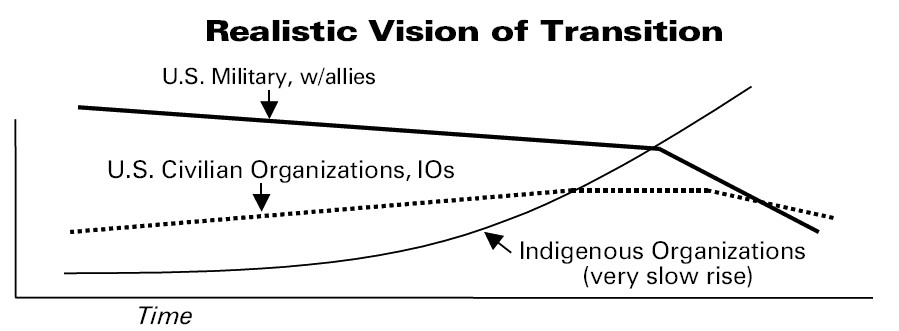
The recurrent argument against dealing with the entire conflict cycle - as described in the Capstone document - is that, after all, war is about warfighting? Alas, not just. Given the means available in the Pentagon budget (again relative to State, CIA, USAid, NSC, etc) it will, in practice, be the military, which is left with the responsibility when things go awry. Just look at this chart from the great Crane/Terrill analysis from February 2003 (whole file here, pdf):


The US military - and the NATO armed forces as well - will in fact be asked to be able to if not formally manage then at least very substantially support whole conflict cycles. Or rather: They will be asked to deal extensively with the Phase IV things, as in Afghanistan, and not many civilian organizations will be there to help. Hence the PRTs.

But exactly this means that the military organizations should see an immediate self-centered interest in getting Shaping/CSE right. This not just conceptually, but also institutionally as an assured part of any two- or three-star's mindset. Shaping/CSE needs strategic attention. And a few bucks. But investing in systematic prevention planning and analysis capabilities will not be expensive.

Coming from a NATO country perspective the change in ambition for the Shaping/CSE JOC is therefore a disappointment. This kind of stuff will not emanate from NATO (SAC(T)). JFCOM needs to show intellectual leadership on this account. But, of course, I have no clue how the change played out - if there was involvement from elsewhere in the process once the scale of the ambition came clear.

And so, nonetheless, it will still be very interesting to the see the final text of the coming CS JOC.

It would be logical if Tom Barnett picked up on this, but he's busy writing the next book (and going to Springsteen concerts).

Wednesday, March 19, 2008

The New UK Security Strategy: Thin, Somewhat Timid

The text is finally out, here. It is fairly brief, and structured this way:
This strategy (...) sets out the guiding principles of our approach (Chapter Two); our assessment of the major security challenges and drivers of insecurity (Chapter Three); our responses to them (Chapter Four); and how we will work together in taking the strategy forward (Chapter Five).
Content:
Chapter One: Introduction
Chapter Two: Guiding principles
Chapter Three: Security challenges
Chapter Four: The United Kingdom’s response
Chapter Five: Working together
It was expected that the strategy would emphasize interagency capability. It does. The initiative is sound: in principle, this would enable the UK government to combine and converge the three D's - diplomacy, development and defense. As such this makes for more effective counterinsurgency - or statebuilding within conflict - campaigns. As development and security converges in and around failing states the most cost-effective form of development in the long run is contested statebuilding.
5.8 This National Security Strategy shows that the Government is committed to working with the whole of society, to build confidence in our core values, our shared approach, and our strong security capabilities. It sets out a new and clearer understanding of what security means and how we need to work together in an integrated and coherent national and international effort. That will enable us to work together to manage risks, harness the opportunities of globalisation, and achieve the single overarching national security objective set out at the beginning of this strategy: protecting the United Kingdom and its interests, enabling its people to go about their daily lives freely and with confidence, in a more secure, stable, just and prosperous world.
The contextual process to the UK National Security Strategy involves a yearly report on progress on challenges and solutions. But the strategy does not - as I suggested should be the case in the previous post - contain inside its concomitant process a systematic role of overview for Parliament. Such a role is being merely being looked into:
5.7 We will publish an annual update on the challenges we face and progress on implementing this strategy. We will consult all Parties and the Parliamentary authorities about how Parliament can play a stronger role in overseeing the development and implementation of this strategy. We have recently concluded a consultation to consider the ways in which Parliament should be involved in decisions relating to the deployment of the Armed Forces into conflict.
The process as envisaged is at least a credible wish list:
Priorities include:
• consulting on a joint Parliamentary National Security Committee to help monitor the implementation and development of this strategy;
• strengthening the work of horizonscanning and forward planning;
• strengthening the capability to offer a strategic perspective on security priorities and improve connections between defence, development, foreign and domestic security strategies;
• creating a national security forum, including representatives from government, politics, academia and others, to discuss strategy and exchange ideas; and
• publishing the National Risk Register (as set out in Chapter Four) and an annual update on the security challenges facing the United Kingdom and progress on implementing the strategy.
That is disappointing. Since the process is not yet formalized at the launch the ship risks being taken over by bureaucratic pirates of e.g. the Foreign Office. Consulting (viz. the 'joint Parliamentary National Security Committee') can mean anything and nothing. And neither that committee nor the 'national security forum' are really given any role that would constitute checks and/or balances. Who will bang together the heads of DfID, Foreign Office and Whitehall?

Finally, the strategic vision itself seems pretty thin. Not much text compared to the number of themes.

Tuesday, July 10, 2007

Civilian SSTR Planning: NSC or Private Sector Lead

There's a huge need for a civilian planning capacity related to SSTR and post-conflict situations (I have written about this before). This need may be the single most important element in the organizational transformation need to prepare ourselves for the next time around.

This blog often takes an American perspective - or looks primarily at American developments. This is because US leadership is paramount. Whatever happens elsewhere is likely to be to small to be consequential or effective. But this doesn't mean that other countries - notably the UK or e.g. Denmark - could not in theory either develop interesting concepts or organizational innovations which might either be of use or inspiration to the US institutions (as in e.g. the PCRU).

Establishing better integrated military-civilian planning is the only way to construct a strategically realistic "total cost of life" approach to future interventions. Such an approach should make clear e.g. the need for civilian (local or external) police forces. Of course, the Dobbins Handbook gives hints but we need more concrete planning.

Evidently, the Pentagon is not going to open their warplanning to civilians - not even the NSC. But it would be helpful if the civilian side could at least know that the Pentagon planning process had or will be reformed in accordance with the DoD Directive 3000.05 (the problem is here that the NSPD 44 formally gives State the lead, and the S/CRS does not have resources even remotely comparable to OSD, Pentagon itself or even JFCOM.

Of course, some of this planning stuff could be produced or at least introduced in generic form by the private and international public sector - here preferably the non-profit side - like e.g. a combination of UN people (from the UNDP plus the Peace-building Commission) and relevant think-tankers like the Dobbins people, and maybe concerted or hosted by the ICG.
But in purely US terms, the NSC could play such a role.

The NSC seems to be the only place where funds can be found for this kind of exercise (given substantive executive interest, i.e. will not happen until the next administration). But this means that now would be a good time to spread such and idea in order for it to be somewhere on the upcoming administrations' agendas. Richard Clarke's great "Against All Enemies" explains and exemplifies how an adept operator can help create leeway for interagency policy development inside the NSC. In fact, as he mentions explicitly, he was part of the process for creating POL-MIL plans starting with Haiti. So the nuts and bolts and precedence are there. As always it is more a matter of political will and focus than anything else.

Monday, July 02, 2007

GAO Report Confirms Civil Planning Need

New GAO report out on US Stability Operations capability and reform (link here is to pdf). From the exec summary:
DOD has taken several steps to improve planning for stability operations, but faces challenges in developing capabilities and measures of effectiveness, integrating the contributions of non-DOD agencies into military contingency plans, and incorporating lessons learned into future plans. These challenges may hinder DOD’s ability to develop sound plans. Since November 2005, the department issued a new policy, expanded its military planning guidance, and defined a joint operating concept to help guide DOD planning for the next 15–20 years. These steps reflect a fundamental shift in DOD’s policy because they elevate stability operations as a core mission comparable to combat operations and emphasize that military and civilian efforts must be integrated. However, DOD has yet to identify and prioritize the full range of capabilities needed for stability operations because DOD has not provided clear guidance on how and when to accomplish this task. As a result, the services are pursuing initiatives to address capability shortfalls that may not reflect the comprehensive set of capabilities that will be needed by combatant commanders to effectively accomplish stability operations in the future. Similarly, DOD has made limited progress in developing measures of effectiveness because of weaknesses in DOD’s guidance.

DOD is taking steps to develop more comprehensive military plans related to stability operations, but it has not established adequate mechanisms to facilitate and encourage interagency participation in its planning efforts. At the combatant commands, DOD has established working groups with representatives from several key organizations, but these groups and other outreach efforts by the commanders have had limited effect. Three factors cause this limited and inconsistent interagency participation in DOD’s planning process: (1) DOD has not provided specific guidance to commanders on how to integrate planning with non-DOD organizations, (2) DOD practices inhibit sharing of planning information, and (3) DOD and non-DOD organizations lack a full understanding of each other's planning processes, and non-DOD organizations have had a limited capacity to participate in DOD's full range of planning activities.

Although DOD collects lessons learned from past operations, planners are not consistently using this information as they develop future contingency plans. At all levels within the department, GAO found that information from current and past operations are being captured and incorporated into various databases. However, planners are not consistently using this information because (1) DOD’s guidance for incorporating lessons into its plans is outdated and does not specifically require planners to take this step, (2) accessing lessons-learned databases is cumbersome, and (3) the review process does not evaluate the extent to which lessons learned are incorporated into specific plans.
The report then confirms what I have said before (in "The Most Unsexy Headline Ever: Planning Capabilities in the Inter-Agency Process"): We need civil planning - or at least: planning for the civilian side of contingency plans. And nobody - including internationally - has the knowhow and the resources to do it but Pentagon.

Tuesday, May 08, 2007

Shaping: Clever Slide and New Name

Just a few notes on the coming Shaping JOC. There is a remarkably clever graphic in the 2005 JFCOM capstone document which clearly deserves wider attention. It shows the move from a sequential conception of conflict management (like wagons on a train) to a parallel conceptualization; and also a move from a purely military to an integrated, political conceptualization of the conflict phases. Note e.g. the role of Stabilization and Reconstruction in violet and orange. I can only blame myself for not flipping through the appendixes earlier, but here goes:
Phases, however, tend to imply a sequential approach to campaigns with an associated lack of flexibility and inadequately reflect the importance of integrated effort among all interagency players. The CCJO acknowledges that “complex adaptive” adversaries and other situations will demand an integrated and flexible approach. A new campaign framework should provide a means to plan, execute and assess campaigns in an integrated manner. This appendix retains the traditional phase titles and includes proposed new phase titles--portrayed as lines of effort (Figure D-1).
Instead of showing these lines of effort in a traditional horizontal array, however, it stacks them vertically, emphasizing the potential for all lines of effort to be applicable throughout a campaign. The lines of effort represent the activities in which a JFC must engage to successfully accomplish objectives during a campaign. They are titled Shape, Deter, Seize Initiative, Dominate, Stabilize and Enable Civil Authority. The aggregate of all lines of effort equate to the full level of effort necessary (in planning or execution) or available (in execution or assessment) to accomplish objectives. (...)

The simultaneous execution of activities within each line of effort reinforces the need to continuously consider activities across all lines of effort during campaign planning and execution. This approach also captures the proportionate levels of activity that may be required to achieve priority objectives. In so doing, it helps the JFC visualize the required activities for future transitions and subsequent operations, reflecting increasing or decreasing levels of effort. As the campaign is executed, the JFC acquires knowledge, extends reach and creates effects. Concurrently, the JFC assesses the changing operational environment and varies the amount of effort within each applicable line while focusing on a series of priority objectives that contribute to achieving the strategic objective. The level of effort will vary depending on the type of operation, and the actual events that occur. Figure D-2 depicts a proportional level of effort for a notional campaign where actual events have modified the framework from what was originally planned (Figure D-1).
Lines of effort demonstrate a more sophisticated approach the future joint force could take in planning, executing, and analyzing campaigns. Although all lines of effort are considered concurrently, some lines will be given priority due to their relevance to the specific objectives assigned. Identifying priorities will help the JFC allocate and re-allocate resources between lines of effort. Figures 1 and 2 reflect the likely need for multiple instruments of national power to engage based on the objectives and therefore helps reinforce the need to integrate interagency activities throughout the campaign.
The 'lines of operation' concept necessitates a broader civil-military (or: properly strategic) conceptualization of conflict. It therefore basically synthesizes the basic challenge in modern warfare and conflict management we are faced with. This includes the clausewitzian goals of transitioning to and from civil ownership of the aggregate process, and the implication of COIN approximate wider political, administrative and economic means and ends. These thoughts looks like a path way toward what Antulio J. Echevarria called for - from a way of battle to a way of war in a proper clausewitzian (i.e. political) context.

Another thing is that apparently, it is likely that the JOC will have its name changed as 'shaping' carries a too meddling connotation. The possible change is understandable to the extent that it follows the same logic as the CENTCOM reasoning behind giving up on the Long War concept.

But it is less sensible if the change merely results in newspeak, i.e. if the JOC will not refer to actual "meddling" practices (with the risk of rendering the exercise futile). Of course, we are here in the midst of the whole, very politically laden "post colonial" debate - over sovereignty. Personally, I'm all for calling things what they are - and it seems that some euphemisms in the development policy circuit could be done without. But that is (albeit only slightly) a different matter.

Monday, May 07, 2007

The Most Unsexy Headline Ever: Planning Capabilities in the Inter-Agency Process

The USG inter-agency process* is dependent upon the planning capabilities of the Pentagon - and maybe it shouldn't be. Increasingly, the inter-agency process is the center of gravity for the United States' aggregate security capabilities (for simplifying reasons, let's stick here to the functional phases of conflict as conceptualized within US defense - phases zero to IV. Obviously, not all conflicts contain use of armed force). But only the US Department of Defense has extensive planning and business development sections working on generalized and concrete preparations for pre-conflict and post-conflict issues.

No-one doubts that the US rules phase III - major combat operations. But the US is not amassing the potential power it has for phases zero and IV. The latter refers to postconflict and the former to preconflict. To each of these belong at set of tasks that are more or less well-described and more or less well-understood. Post-conflict is a more well-described in terms of probable solutions and possibly better understood than pre-conflict. This is because post-conflict is more clearly a challenge for concrete organizations - ours, at least to begin with.

Post-conflict refers to both a complex organizational and logistic task (establishing country and government-wide administrative functioning organizations through military and civilian capabilities while/and handing them over to the host nation) and a strategic task namely identifying the wanted host national endstate, in fucntion of feasibility and ambitions (the choice is evidently shaped by political and anthropological both ramifications and limitations). To this effect, JFCOM has created the SSTR JOC which describes in general terms the challenges and is used as basis for doctrine development; Pentagon has issued the DoD Directive 3000.05, which sets SSTR Ops on par with major combat operations (i.e. the military has to be able to brak stuff efficiently and to hand over the pieces to subsequent civilian authority in accordance with the overall, wanted political endstate); and State has been given coordinate authority over phase IV so that the military in principle only has a supportive function - the chief of State's Office for the Coordinator of Reconstruction and Stabilization (S/CRS) is in charge of coordinating this particular element in the inter-agency process (not really sure how it/he formally ties in with the NSC which is in charge of the overall process).

Pre-conflict on the other hand is about identifying and addressing - ultimately managing - emerging conflicts so that they do not evolve into something we cannot live with for humanitarian or security reasons, or both. If we put on the USG glasses then, in principle, this challenge calls for both civilian and security (military and covert) means, because the challenge in itself has a political and anthropological character - it cannot be purely military. Much of the existing framework of international organizations and here especially the UN deals with pre-conflict. Development policy itself is a central piece in this puzzle. Conceiving of development policy as a means in to a pre-conflict management end is controversial but helpful.

Pre-conflict there has not recieved the same institutional attention as post-conflict. Only the JFCOM is developing a new Joint Operating Concept for 'Shaping' operations. The CINC at AFRICOM will be likely to get the responsibility for contingency planning like the other CINCs have. A number of these will be proper war plans. The majority will likely deal with evacuation, humanitarian assistance and especially FID, COIN and counterterrorism - foreign internal defense operations and (support to) counterinsurgency. But the most consequential work, if the AFRICOM commander gets it right, will be based on the conceptual work being done on pre-conflict issues.

There is an institutional trap here: the military traditionally is very strong in war planning. In its self-understanding the military exists to carry out major missions. These are represented in war and contingency plans. But the pre-conflict logic is more civilian, oriented towards day-to-day process of political subjects (but it is at the same time more general, strategic than a war plan case). The challenge for both JFCOM and AFRICOM will be to enhance the pre-conflict stuff to the same institutional importance as those threats that can be addressed through war planning.

The military develops and produces contingency planning and joint concepts at COCOM and JFCOM levels. No such equivalent exists within the civilian apparatus. The US military has some unique institutional strengths in planning and concept development, both in terms of talent and numbers, and in terms of formalization of process. The civilian side could learn a lot from these guys.

But there is an institutional imbalance here. Neither State Department or the NSC have ressources for strategic planning comparable to Pentagon's. Pentagon is 'only' responsible for developing plans and JOCs in support of the overall USG inter-agency process on pre- and post-conflict where the civilian agencies are in the lead. One solution is of course for e.g. the AFRICOM commander to involve or integrate civilian agencies very much up front in strategic planning and forecasting. But even if this is an understandable and pragmatic approach there is something lopsided about a process that will then hinge the institutitional setup of carrying out US foreign policy (State's domain) on the individual character of e.g. the AFRICOM commander. In the end, pre-conflict management can then be boiled down to whether the given commander 'gets' the political and anthropological stuff.

That seems like an unnecessarily contingent element.
Maybe State Department or the NSC should get into the conceptual development and planning work on their own account so that they get a better - more strictly institutionalized - chance of getting heard? That might also ensure, that the military winds up with less situations where they are formally in a supportive function while really having to do it all.


______________
* For the non-US reader: the 'inter-agency process' is the term describing the policy coordination going on inside US Government (USG). The National Security Council is the agency responsible for the process concerning national security matters.

Tuesday, March 20, 2007

Shaping Input: Africa's Horn in Foreign Affairs

The new issue of Foreign Affairs features a fine article on the conflicts – present and lurking – on Africa’s Horn, and the weaknesses of US policy ("Blowing the Horn", subscription required).

People at JFCOM currently working on the coming Shaping JOC are well advised to read John Prendergast and Colin Thomas-Jensen’s article. The challenges and solutions that they outline are basically what the JOC will have to address: learning full-scale diplomacy not in its diplomatic sense, but rather as a holistic problem-solving approach, which includes addressing grievances and issues over livelihoods.

The essential lessons of U.S. counterterrorism policy over the last five years – apparently unheeded by the Bush administration – is that in order for local Muslim populations to take the United States’ counterterrorism agenda seriously, the United States must take their state-building and power-sharing agenda seriously, too. Ironically, the strategy is already there on paper. In its 2002 National Security Strategy and elsewhere, the Bush administration has argued that failing states foster terrorism and has laid out a comprehensive approach to counterterrorism that involves promoting peace building, state reconstruction, and good governance. When it comes to the Greater African Horn, however, the Bush administration has simply not implemented its own policies. By relying on sporadic military strikes and continued support for autocrats without broader political planning, it has combined the worst elements of its current strategy in Iraq with the Cold War-era policy of cronyism. Conflict resolution and good governance are, in fact, the keys to countering terrorism in the Greater Horn of over the long term.

More on the Shaping JOC in this post – including the natural African focus of the JOC and here especially the CJFT-HOA. People who should also read their article include the CIA analysts involved not only with HOA related stuff, but also those working on projects similar to the Shaping JOC.

A final aside: Not surprisingly, the sharpest minds on the intricacies of policy development are no longer to be found in academia: they are more often at the best think tanks – and among them evidently the ICG where both authors reside.

Sunday, February 11, 2007

The Coming JFCOM 'Shaping' JOC: A Revolution In Development Policy?

The creation of African Command (AFRICOM) is accompanied by a the development of a new Joint Operating Concept (JOC) with potentially huge ramifications for the continent and for the whole development sector -- including the largest non-American partners, from the national development agencies (DfID, Danida, etc) over the EU and especially the UN to of course the 'host nations' in particularly Africa.

This new JOC is called Shaping. It is the logical prequel to the SSTR JOC -- published in its final version in December 06 after several years of preparation. The SSTR JOC deals with Stabilization, Security, Transition and Reconstruction Operations and is the new version of the old S&R. The inclusion of especially transitioning points to the growing understanding within the Pentagon system of the importance of founding the conceptual thinking about use of force on a properly clausewitzian basis: namely that military operations must always be thought of as an element in a larger political concept (not to say that MCOs do not have to function in a more clearcut independent way). The philosophical critique has been expressed particularly well by Antulio J. Echevarria, e.g. in this paper Toward An American Way of War. The SSTR JOC basically underpins all MOOTWs including counterinsurgency.

SSTR Ops are those contained inside what is known as Phase IV: what comes after Phase III or MCO (Major Combat Operations). As I wrote in a report on Transitioning (in Danish), back in summer '05, this distinction between the phases is breaking down: the subsequent publication of the DoD Directive 3000.05 which puts SSTR on par with MCO within the US military; the NSPD 44, which gives States responsibility for Phase IV; and the extensive work going on in all sectors of USG to improve inter-agency cooperation, planning and training (without much to show for it so far) shows how the breakdown is real but also causing a lot of headaches.

Where SSTR equals Phase IV, the Shaping JOC is then tasked with dealing with Phase 0. Phase 0 is about prevention of conflict, and should in this perspective be understood as an element in the Long War ... or the GWOT (global war on terrorism) as it apparently and weirdly still is called in Pentagon circles. This PPT file shows not only the timeline for the new Shaping JOC (version 1.0 is due in August '07) but also the basic aspirations of the JOC:
Military Problem: In the complex future environment, economic, demographic and societal stressors will lead to areas of instability. Future state and non-state adversaries, to include extremist ideologues, will use all means available to:
  • exploit this instability by undermining partnerships and further destabilizing weak governments,
  • deny or disrupt US influence or access, and
  • gain sanctuary in ungoverned, unstable, and remote areas
The future Joint Force Commander must be capable of working both unilaterally and closely with multinational, interagency and other partners to maintain or enhance stability, prevent or mitigate crises and set the conditions for access and responsive crisis intervention.

Scope: This JOC will focus on the actions a joint force commander might take in the context of unified action to advance US interests by:
  • building partnership capacity
  • influencing non-partners and potential adversaries
  • mitigating the underlying causes of conflict and extremism; and
  • setting the conditions that enable rapid action when military intervention is required
Proposed Solution: The Joint Force, as a part of a larger multinational and interagency effort, conducts continuous, anticipatory shaping operations that build partnerships with governmental, nongovernmental, regional and international organizations and reduce the drivers of conflict and instability in order to prevent or mitigate conflict or other crises and set the conditions for success in other operations—all aimed at a secure global environment favorable to US interests.
How do you '[mitigate] the underlying causes of conflict and extremism', and 'mitigate conflict and other crises'? Well, this is exactly the work of the aggregate development organisations: from the UKs PCRU and USAID plus international NGOs like the ICG to more long-term development organisations like UNDP. Mitigating underlying causes of conflict means addressing grievances before they turn into rebellion ... it means strengthening the local state so that it delivers to its citizens: from basic infrastructure, a working, stable and sustainable economy that provides jobs, rule of law and a decent political system.

The Pentagon will have their hands full -- and it is extremely important that they get the conceptual thinking right here. I hope the drafters will consult leading civilian development and political science experts and the extensive social science insights inside the CIA.

As a consequence of the NSPD 44, both the SSTR and the Shaping JOC are entitled "Military Support to..." but the Shaping PPT nevertheless underlines the probably necessity for the military to be able to deal unilaterally with the issue, i.e. have the capabilities to carry out these things without the interagency process. This is true also for SSTR: in many situations the military is the only organization present, as is visible in e.g. Afghanistan.

What are the ramifications? On the Pentagon side, the answer depends not only on the thinking to be done, but also on the implementation. The interesting thing here is that AFRICOM will offer the Shaping JOC a natural home (EUCOM shares the lead on the JOC development with JFCOM: will probably be transferred to AFRICOM?) -- it will not have to battle (a losing) struggle to get influence within the other COCOMs. Its reception within SOCOM is, however, very important.
As Tom Barnett has noted, the existing CJTF-HOA will probably form the basis for AFRICOM even if it is placed in Stuttgart to begin with. Stuttgart is also the home of a SOCOM force (10th Special Forces Group, 1st Battalion). This may be a coincidence but it is probably not: The Long War's shaping missions will not solely be about development-like issues but will also include sharp-end elements, which is where the special forces come in handy as they excell in these more surgical operations. AFRICOM's tasks may be very political in nature but they will include very military means.

On the civilian side, including the whole of the development universe: You better wake up and follow this development closely. The Pentagon has so much logistical and funding clout that if the Shaping concept does indeed get feet, then there will be some very real opportunities to move the development agenda forward. My guess is, however, that most likely the development crowd will shy away from cooperation with the Pentagon. This is especially the case for the European development agencies.

Finally, there is NATO: This is stuff which should interest the CIMIC Centre of Excellence, but also people at higher echelons: anyone in the NATO militaries dealing with strategic planning.

This is a thing to be followed closely!

____________________________________________________
EDIT: This old post gets a lot of readers. Please do not miss the later posts on Shaping, either by clicking here (and show all posts on shaping); or by going to these two posts, which further follow and evaluate Shaping/CSE:

Friday, December 15, 2006

Iraq: Pace Recommends Finally Taking Reconstruction, Political Side Serious

The Pace study is finished and Bush has been briefed on the top brass recommendations. Crucially, they agree with the Baker-Hamilton report on turning from combat to training -- plus more focus on and effort in reconstruction. Here, from the Washington Post:
The chiefs do not favor adding significant numbers of troops to Iraq, said sources familiar with their thinking, but see strengthening the Iraqi army as pivotal to achieving some degree of stability. They also are pressing for a much greater U.S. effort on economic reconstruction and political reconciliation.

Sources said that Gen. George W. Casey Jr., the top U.S. commander in Iraq, is reviewing a plan to redefine the American military mission there: U.S. troops would be pulled out of Iraqi cities and consolidated at a handful of U.S. bases while day-to-day combat duty would be turned over to the Iraqi army. Casey is still considering whether to request more troops, possibly as part of an expanded training mission to help strengthen the Iraqi army.

The recommendations Casey is reviewing to overhaul the military mission were formulated by Lt. Gen. Peter W. Chiarelli, the outgoing top U.S. ground commander, officials said. The plan positions the U.S. military to be able to move swiftly to a new focus on training, one of the key recommendations from several reviews of U.S. strategy, including from the bipartisan Iraq Study Group.

Under the plan developed by Chiarelli's staff, the military would shift about half of its 15 combat brigades away from battling insurgents and sectarian violence and into training Iraqi security forces as soon as the spring of 2007, military and defense officials said. In northern and western Iraq, U.S. commanders are already moving troops out of combat missions to place them as advisers with lower-level Iraqi army units, Maj. Gen. William Caldwell, spokesman for the military in Iraq, said yesterday at a briefing in Baghdad.

Administration officials stressed that Bush, under pressure from Congress and the electorate to abandon the United States' open-ended commitment, has made no final decisions on how to proceed in Iraq. But the new disclosures suggest that military planning is well underway for a major change from an approach that has assigned the bulk of responsibility for security in Iraq to more than 140,000 U.S. troops.

The chiefs also want to see a new push on political and economic issues, especially employment programs, reconstruction and political reconciliation, to help quell the problems that have fueled both the Sunni insurgency and Shiite-Sunni sectarian strife, say defense officials and U.S. military officers in Iraq. A new jobs program is considered key to pulling young men from the burgeoning militias.

Pentagon chiefs think that there is no purely military solution for Iraq and that, without major progress on the political and economic fronts, the U.S. intervention is simply buying time, the sources said. They particularly want to see U.S. pressure on the government of Prime Minister Nouri al-Maliki to offer amnesty to Sunni insurgents, approve constitutional amendments promised to the Sunni minority, pass laws to ensure equitable distribution of oil revenue, and modify the ban on members of Saddam Hussein's Baath Party taking government positions.

Bush alluded to this proposition when he met briefly with reporters after his meeting at the Pentagon. "Our military cannot do this job alone," he said. "Our military needs a political strategy that is effective."

But Bush also showed no sign that he is retreating from his basic proposition that the U.S. military must be engaged in Iraq for some time. "If we lose our nerve, if we're not steadfast in our determination to help the Iraqi government succeed, we will be handing Iraq over to an enemy that would do us harm," he said, adding that he would not be "rushed" into a decision.

This is evidently the right choice: the training mission was announced 2½ years ago, but has not had the substantial weight and smell of strategic-choice-importance until now. Yet, focusing on training properly brings its own problems. Greg Jaffe had fine piece on this in the WSJ recently, "U.S. Commanders Advance Plan To Beef Up Training of Iraqi Army":
Senior U.S. military commanders in Baghdad, eager to shift the fight in Iraq to that country's army, are advancing a plan that could more than double the number of American troops involved in training Iraqi soldiers. The tentative plan, which calls for breaking up some big U.S. combat units into military-training teams, reflects a major shift in U.S. tactics, and meshes with one of the key recommendations of a high-profile report released Wednesday by the bipartisan Iraq Study Group. The new approach isn't expected to require a marked change in the overall number of American troops in Iraq. But it would increase the number involved in advisory roles to as many as 10,000, from the current 4,000, senior military officials said. (...)

Senior military officials are betting that larger U.S. military training teams that would live and work with Iraqi units could speed the development of an Iraqi army force that has shown some promise, but is still bedeviled by corruption, absenteeism and logistical problems. How quickly the Iraqi army improves could ultimately determine how quickly U.S. troops could withdraw from the country.

However, even the staunchest advocates of building up the Iraqi army warn that the strategy carries significant risks that could derail it. In the near term, commanders say, shifting more U.S. troops into training and advisory jobs could lead to an increase in sectarian violence in Baghdad, because there would be fewer U.S. troops patrolling the streets. Iraqi army units and their U.S. trainers would have to pick up the slack.

The idea of shifting more U.S. troops into training roles has been kicking around in Baghdad and the Pentagon at least since spring. Multiple internal studies by the U.S. Army have concluded that its current training teams in Iraq, typically 10 to 12 U.S. soldiers per an Iraqi battalion, are too small to be effective. (...)

A big concern with the plan is how to protect U.S. soldiers serving on advisory and training teams. These troops would be prime targets for insurgents and sectarian militias seeking to stymie the progress of Iraqi units. They would also be vulnerable if their Iraqi units were overrun by the enemy. Senior U.S. military commanders also warn that without progress on rebuilding Iraq's economy and without a political accommodation between Iraq's Shiites and Sunnis, no military force will be able to impose order in the country. "The military cannot win this alone -- it's flat impossible," said one senior U.S. official.

U.S. training teams now live and focus on advising Iraqi battalion commanders, who each oversees about 500 troops, plus staff. Under the new plan, the expanded teams would spend more time with the lower-ranking commanders and their troops who do most of the day-to-day fighting and patrolling in Baghdad. U.S. commanders say the larger teams would be better able to prevent abuses by the Iraqi units and ensure that they do their jobs properly. "Beefing up the training teams will give us a 24/7 presence in the Iraqi units that we haven't had so far," said a military official. Some officers who have recently served on U.S. military training teams in Iraq praised the effort to focus more troops on the training mission. But they cautioned that this wouldn't fix many of the Iraqi army's biggest problems. Many Iraqi units continue to be hamstrung by ineffective or corrupt commanders who have the support of key officials in Iraq's Ministry of Defense. "Right now we cannot even fire Iraqi army leaders [whom] we know cooperate with insurgents or are incompetent," said Lt. Col. David Coffey, who returned last month from Iraq, where he had served on a 10-man training team.

The supply system often fails to deliver Iraqi troops the fuel, food and bullets they need to carry out their missions. Several advisers said there is also pressure to inflate the capabilities of the Iraqi units in readiness reports. "There is tremendous pressure on the training teams to show steady progress in the abilities of the Iraqi battalions," Col. Coffey said. "This ignores the fact that many units actually get worse as key leaders are killed or go AWOL, as unit equipment degrades, as the enemy situation gets worse, or as combat operations prevent ongoing training."

The U.S. soldiers who make up the military training teams cannot order Iraqi commanders to carry out missions. Instead, their job is to advise, cajole and set a good example for their Iraqi counterparts. The teams help the Iraqi forces plan raids, set training schedules and get necessary supplies. They also act as a conduit to U.S. forces in the area.

Moreover, as Tom Barnett points out, under the heading "One More Thing The Military Is Good For", the Pace recommendations are politically useful for President Bush:
On the Joint Chiefs' recommendation, I don't see much difference from the ISG. In sum, it also says pullback from combat, train up Iraqis and support them, and... Oh yeah... always hunt terrorists. I think we have a consensus, but since the Chiefs won't comment on dialogue with Syria or Iran (foreign policy turf), this way Bush can say he's listening to his generals while he blows off the ISG's call for a regional security/diplomatic initiative. That, my friends, is some military cover.

Hardly part of the Chiefs analysis, but hey, useful nonetheless.

Tuesday, December 05, 2006

Phase IV & Iraq: Rummie Still Doesn't Get It

Apologies to regular readers for hiatus: new job brought new responsibilities and opportunities. To the heart of the matter: Rummie still doesn't get it. 'Still' as in in not learning from the stupid choice on Phase IV (post-major combat) Ops in Iraq, especially concerning footprint size.

The
Rumsfeld memo was interpreted by the NYTimes as being an expression of him not knowing he was leacing office: I disagree. The memo looks more like an attempt at legacy-making ("I said so, but...").

The present brouhaha over directions on Iraq (not that I belittle the challenges) notwithstanding, the memo is interesting because it reveals that in spite of his greenlighting of the DoD 3000 (more
here), Rumsfeld still does'nt (didn't) get the challenges of Stabilization and Reconstruction (S&R). This fact is most visible in the lead-in to the memo -- through the sin of omission:

The situation in Iraq has been evolving, and U.S. forces have adjusted,
over time, from major combat operations to counterterrorism, to
counterinsurgency, to dealing with death squads and sectarian violence. In my
view it is time for a major adjustment.

Unless counterinsurgency here is to be taken in the wider form advocated by many: as profoundly political operation type including heavy civilian side investment S&R is nowhere here. The trouble is, of course, that no one else then Pentagon is there or has field incentives to deal with the challenges. The interagency issue appears as the fundamental challenge in everything we try to do:
Aggressively beef up the Iraqi MOD and MOI, and other Iraqi ministries critical
to the success of the ISF — the Iraqi Ministries of Finance, Planning, Health,
Criminal Justice, Prisons, etc. — by reaching out to U.S. military retirees and
Reserve/National Guard volunteers (i.e.,
give up on trying to get other USG
Departments to do it.
) [emphasis added]
The Pentagon issued DoD Directive 3000.5 has effectively been undercut by the NSPD44 (which hands final responsibility for reconstruction to State i.e. the civilian side).

Coalition forces are mentioned briefly: as part of pedagogical drawing dawn in order to make ISF 'pull their socks up', and, implicitly, let them stay in terms of SOF and explicitly as key partners on training of ISF. Training emerges as the next big thing in Security: building effective and just institutions to take well care of their country. Oops, did that sound as Development? Indeed, it did.

The military tasks we undertake today and tomorrow will look more and more like development in their longterm goals -- and so their means. Rumsfeld didn't get that, and Gates probably wont either as he is a safe fallback guy. But I hope to be wrong.

Wednesday, November 15, 2006

African Command: Funky Pentagon Visions

Apparently, the visions working their way around the Pentagon for the expected new African Command are far more colorful than one would have imagined just a few months ago. According to the Voice of America:
The U.S. Defense Department established a working group Monday to develop a detailed plan by early next year for a possible new Africa Command in the U.S. military structure. But an official familiar with the process says such a command could look very different from the five existing U.S. regional commands. The Pentagon has established an Implementation Planning Team, and it takes the effort to create an Africa Command to a new level of intensity. The issue has been under discussion by the staff of the top U.S. military commanders for about two months.

Now, according to a Pentagon official who requested anonymity, the effort is being expanded to involve a couple of dozen people working full time. (...) The spokesman says the Pentagon is seeking more effective ways to improve counter-terrorism cooperation, prevent and respond to humanitarian crises, and promote stability in Africa. He says the U.S. government is consulting what he calls "key foreign security partners" as the Africa Command plan is being developed. (...)

This official says, if Africa Command is created, it could look quite different from the other U.S. regional commands. Those commands are organized first and foremost to fight wars, although they are also involved in a variety of non-combat operations, such as humanitarian relief and training. The official says the planning group is considering flipping that model for Africa Command, organizing it primarily, or perhaps even exclusively, for non-combat operations designed to prevent wars.

The official also says the team working on the Africa Command issue recognizes that the continent's problems are not primarily military. He says that is why representatives of other U.S. government agencies have been brought into the process, and may also have more substantial representation in the structure of the command itself than they do in other U.S. regional commands.

Basically, then, the new African Command would deal with foreign policy: economic development and political stabilization. It will be interesting to see whether Pentagon really means it -- and will be willing to integrate and coordinate with (even on some choices subordinate itself to) e.g. USAID. The sensible international version would essentially include the already existing multilateral universe, from foreign development partners such as IMF, WB, UNDP ... and the EU, whose civil crisis management capabilities are growing and are being considered deployed to Afghanistan to support the NATO operation there.

Even merely partially played out this way would be akin to the intention of the QDR Long War conceptualization. The narrower we-didn't-mean-it-that-much version would keep African Command focussed on security issues (but as said not warfighting), meaning that it would do PKO coordination and training (like the African PKO training programmes) plus different kinds of internal assistance ranging from (military) security sector reform to foreign internal defense operations and operational assistance with counterinsurgency.

This latter model is the minimum -- but it would be interesting to see elements of the former included, at least in terms of organs for operative coordination (the inter-agency problem revisited). The challenge here is to find a way of organizing coordination without hierarchy -- between only partially aligned mission definitions and especially self-conceptions from civil multilateral to military national perspectives.

Thursday, October 05, 2006

The New African Command: Air Force Components Emerging?

As the Pentagon moves further towards officially announding the creation of an African Command -- as proposed early on by Tom Barnett; and suggested close by this Time Magazine piece back in late August -- small signs of the concomitant reorganization of assets can be found ... or am I just looking too hard? Take this item from Stars and Stripes today:

KAISERSLAUTERN, Germany — Nearly a year after deactivating the historic 3rd Air Force, the Air Force is bringing it back. But what the headquarters command will do, where it will go and why it is coming back, officials will not say. Brig. Gen. Michael Snodgrass, director of Plans, Programs and Requirements at U.S. Air Forces in Europe headquarters, confirmed the command would return but told Stars and Stripes he could not give any details because they were still being negotiated by the Pentagon and the U.S. State Department. Nations involved in the reorganization also must be notified. (...)

The 3rd Air Force officially was deactivated during a ceremony in England last November. The Air Force shuttered the headquarters as part of a plan to merge commands and create a new one at Ramstein. About 100 staff members from the 16th Air Force based at Aviano Air Base in Italy and the 3rd Air Force in England moved to Germany to create a new, 650-member “warfighting” headquarters with the job of planning combat and humanitarian operations.

The new African Command might just be where the 3rd Air Force is going. EUCOM's strategic importance has dropped a lot since the end of the Cold War. Reducing numbered European USAF Air Forces to two therefore made sense in an efficiency oriented perspective. But then most of EUCOM's operations are NATOesque 'out of area' -- more precisely: out of Europe, into Africa -- operations. This focuses a large chunk of Air Force activities on one specialized kind, namely long range contingency operations in various shapes. 3rd Air Force has been doing this since the mid 1990's at least (GlobalSecurity.org never ceases to amaze).

Back in December last year, I wrote about the impossibility of a Civilian Transportation Command for civilian contingencies, Stabilization and Reconstruction, disaster response, etc. This means the military, and especially, the USAF will have to literally carry the major weight in the growing area of joint, inter-agency and multinational operations -- and especially, overlapping civilian and military operations, whether proactively pre-conflict or reactively post-conflict. 3rd Air Force could be brought back as a component in the African Command, leaving Rammstein as the EUCOM AF HQ component.

Wednesday, September 06, 2006

The New Terrorism Strategy: Long War Challenge Still Not Resolved

In anticipation of the 5-year mark of 9/11, the Bush administration has unveiled its new National Strategy for Combating Terrorism, while Democrats have unveiled their critique of the accomplishments (New York Times, hat tip to a friend). The CSIS people have their own evalution coming out tomorrow in the shape of a book (link courtesy of Dan Drezner), but the teaser quoted below is available for mere mortals. From the Washington Post, "Bush Warns Of Enduring Terror Threat":
Meanwhile, the bipartisan Center for Strategic and International Studies issued a report saying that although the Bush administration has deprived al-Qaeda of sanctuary in Afghanistan and has prevented more attacks on U.S. soil in the past five years, it has not tracked down bin Laden or created "enduring security in Afghanistan." Moreover, the report said, the administration's attempts at public diplomacy are "undermined by perceived U.S. unilateralism."
Two points: one on the NSCT as example of Long War-policy problems and another, more general, observation about the production of ideas in US foreign policy in light of that policy challenge. First, the NSCT is one -- important -- 'doctrinal' element in the implementation of the Long War concept as a header for the struggle against violent extremism formerly known as the Global War on Terrorism (GWOT). The NSCT illustrates these challenges in presenting one long-term goal (spread of Democracy) and four shorter term initiatives (Prevent attacks by terrorist networks; Deny WMD to rogue states and terrorist allies who seek to use them; Deny terrorists the support and sanctuary of rogue states; Deny terrorists control of any nation they would use as a base and launching pad for terror). But these four are complimentary rather then essential to the first:
The long-term solution for winning the War on Terror is the advancement of freedom and human dignity through effective democracy. Elections are the most visible sign of a free society and can play a critical role in advancing effective democracy. But elections alone are not enough. Effective democracies honor and uphold basic human rights, including freedom of religion, conscience, speech, assembly, association, and press. They are responsive to their citizens, submitting to the will of the people. Effective democracies exercise effective sovereignty and maintain order within their own borders, address causes of conflict peacefully, protect independent and impartial systems of justice, punish crime, embrace the rule of law, and resist corruption. Effective democracies also limit the reach of government, protecting the institutions of civil society. In effective democracies, freedom is indivisible. They are the long-term antidote to the ideology of terrorism today. This is the battle of ideas. (...)

The strategy to counter the lies behind the terrorists’ ideology and deny them future recruits must empower the very people the terrorists most want to exploit: the faithful followers of Islam. We will continue to support political reforms that empower peaceful Muslims to practice and interpret their faith. We will work to undermine the ideological underpinnings of violent Islamic extremism and gain the support of non-violent Muslims around the world. The most vital work will be done within the Islamic world itself, and Jordan, Morocco, and Indonesia, among others, have begun to make important strides in this effort. Responsible Islamic leaders need to denounce an ideology that distorts and exploits Islam to justify the murder of innocent people and defiles a proud religion.
This is either pretty fluffy or strangely selective stuff. It doesn't even amount to what it probably would like to be: an indirect call for an Islamic Reform (that would bring with it a, less related, set of problems). Taking the NSCT in its context, the change from GWOT to Long War implies a change from military means to political means (or at least, to employing military means within a more clearly politically directed context and as such for political ends). In military terms, implementing this change means higher emphasis on counterinsurgency and other politically aware military operations types, as exemplified in the 2006 Quadrennial Defense Review.

Because the goals are fundamentally political, the Long War must necessarily also be more political in the means than in the GWOT framework. Meeting the Long War challenge means embracing the convergence of Security and Development, and understanding that not only is the latter probably a cost-effective way of achieving the first: it may also be the only way. The discrepancy in the NSCT between the short term initiatives and the long-term goals is not surprising -- but it needs to be resolved for the Long War not to be a mere continuation of the GWOT. The CSIS people take stock in their brief document of the U.S. strategy and capabilities for "winning the Long War":
Accomplishments
Established principle of sovereign accountability (no “safe harbor”) for terrorists
Renewed DoD emphasis on counterterrorism and irregular warfare
Increased Special Operations Forces capabilities, cultural awareness, linguists
Raised priority for building foreign capacity
Created State Department Office for Reconstruction and Stabilization

Continuing Challenges
No grand strategy or interagency concept of operations for the “long war”
Overemphasis on use of military, creating substantial strains on forces
Insufficient deployable operational capacity in civilian agencies
No master plan to coordinate “soft power” programs
Chronically weak interagency coordination, planning, and operations
The CSIS challenges list is sound: an interagency concept is needed, but without resolving the underlying tension between Pentagon and the rest of the agencies, most notably State, about who should be responsible for what and have the necessary means to carry it out. Since this includes finding the political will to fund a substantial enlargement of civilian deployable capabilities -- the interagency concept looks like a difficult thing to write. Of course the recent Pentagon re-evaluation of the central status of inter-agency capacities is a step on the way (see: Pentagon Ups Inter Agency Capability) -- just like the NSPD44 is the basic stepping stone for all further developments as it gives State ultimate responsibility for stabilization and reconstruction. Tom Barnett's vision for a Department for Everything Else, including the S&R bit, and thus gathering the nation-building elements (or SysAdmin, as he calls them) from the Pentagon and State, is radical but a logical solution to the fundamental strategic challenge. We may be heading in that direction but the civilian side deployment capabilities issue is crucial for it to happen.

Second, the NSCT exemplifies that the civilian side needs to learn from the military in terms of defining strategies proper. The NSCT is a good example of the actual development of the aggregate US foreign/security policy strategy hierarchy. In principle, this goes from the abstract, general description of threats and responses and means -- the NSS -- over sector designated descriptions -- the National Military Strategy, the National Strategy for Combating Terrorism, the Homeland Security Strategy, etc. -- to even more specialized levels including operations doctrines until the level of field manuals. Maintaining this system logically congruent would mean changing the NSS first always, then subsequently the rest.

In reality, however, the different documents are updated less dependently. Different departments are in touch with different parts of an evolving situation and react with different speeds. In a way, this is a characteristic of a soundly working system of strategies: the concept of identifying a wished-for end-state, with means and ends allows for a clearer evaluation of changing effects of threats and reactions, and therefore visible and -- in principle -- accountable changes in a coherent policy.

But, as all of the important changes in this non-hierchical way have come from the military circuit -- for logical reasons as the military have met and meets the concrete challenges of first the GWOT and then the LW. But this is a problem for effectively resolving the LW challenge: the military knowledge production circuit has little institutional incentive to think much beyond the confines of military operations. The gap of the NSCT therefore demonstrates the need for 'civilian' academics and policy people to engage with the practical task of filling the strategy gap of the NSCT -- but in a way that is not too 'civilian', so that the result becomes something to implement in practice. The civilians' dare: come up with a strategy that can fulfill the political task of the Long War in strengthening democratic statehood in the long term while addressing the immediate and medium term challenges.

Thursday, August 31, 2006

Pentagon Ups Inter-Agency Capability

Good stuff: this is most important piece of Pentagon reorganization news since the NSPD 44 and the DoD Directive 3000 (extensive quote, but its worth it):

The Pentagon announced on Aug. 28 that it would create a new assistant secretary's position to help coordinate inter-agency operations. Mid-level U.S. military officers will also begin to receive intensive instruction on the planning and command of overseas operations in partnership with civilian agencies. The military is seeking to embed the lessons learned during flawed inter-agency operations in Iraq and Afghanistan, and protect its own primary leadership role in future overseas interventions. The Pentagon-led effort in Iraq is faltering, but the Department of Defense (DoD) is determined to retain its leading role in planning and executing U.S. operations abroad. To this end, it is seeking to strengthen its role "coordinating" the activities of civilian agencies:

Inter-agency training: Courses at the joint-service National War College and the Army, Air Force and Navy/Marine Corps Staff Colleges are designed to prepare lieutenant colonel-level officers for progression to the most senior ranks. This year, they will also include higher numbers of mid-level officials seconded from civilian agencies.

Iraqi lessons: In Iraq and Afghanistan, the military was poorly prepared for the transitions from war fighting to stabilization and reconstruction operations. The Pentagon hopes that the joint training of senior officers and civilian officials will help establish routine inter-agency cooperation and consultation.

Maintaining control: Although conducted in a spirit of common purpose, the new courses are also an act of self-preservation on the part of the Pentagon. The relative standing of the military and civilian agencies in planning and commanding "multi-agency" operations is in a state of flux and could yet fall between three broad models:

Continued Pentagon dominance: In the wake of the Iraqi experience, future operations are likely to have a significantly enhanced civilian presence at every stage of the planning process. However, civilian agencies may continue to report to the commanding military officer.

Joint military-civilian control: Operations planning may evolve into a dual command structure, with military and civilian commanders sharing authority.

Civilian leadership: An unlikely, but conceivable outcome could be overall civilian command of future operations, with the military performing specific supporting tasks.

In 2004, the administration created a new State Department-based Office of the Coordinator for Stabilization and Reconstruction (S/CRS), a move that was widely interpreted as confirming a shift towards the joint military-civilian command model. However, in practice, the creation of the S/CRS has raised more questions than it has answered about the military-civilian operational relationship:

-- Although based in the State Department and headed by a senior ambassador, the new office has drawn many of its personnel from within the DoD. It has also relied heavily on DoD contingency funding and has worked alongside the operational commanders in Iraq and Afghanistan.

-- The emergence of the S/CRS as a partner to the military in the planning and command processes has coincided with the re-classification of stabilization and reconstruction operations, by the DoD, as a "core" military activity.

This new assistant secretary position along with the initiatives is a very welcome element in implementing the whole ability of the US military to not only conceive of war within a context of everything else (in the words of Thomas P. M. Barnett). But also act that way: in a proper Clausewitzian fashion, that is seing its core job to be a functional element within a larger - political - process were the use of force is not an end in itself, and the mastering of this ability therefore cannot be the sole focus in training, management, doctrine ... in short, in pratice.

Too busy to describe further ramifications, but they include questions like: will this add to a clearer division of labor within US foreign policy (State vs. DoD)? Will they both try to cherry pick the juiciest pieces and leave the hard stuff unassigned? Will the division of labor and cooperation include and to which degree successfully the UN response organizations, NATO and NATO country equivalents of USAID? How much support and weight does the new under secretary get in the Pentagon internal game? Etc.

Anyway, this is truly good news. Danish readers may consult my DIIS-report Transition til statsbygning efter intervention (i.e. Transition to state-building after intervention) from October last year, which included recommendations in this direction. Related earlier posts include (earliest first):

* Blair's Long War Vision
* The Barnier Report: Slow Step Towards A European State-Building Agency
* USAID's Office of Military Affairs
* UN Peacebuilding Commission: Good, but Still Dependent on the Pentagon
* Cato's Critique of S/CRS is Wrong
* A Civilian Transportation Command?
* Transitioning Rocks: Will DoD and State Deliver?

Tuesday, February 21, 2006

Effects Based Cultural Awareness

The Pentagon's modernization process known as "transformation" has been aiming at moving from "capabilities" to "effects" based thinking and planning since the 2001 QDR. One more surprising outcome of moving toward effects based thinking in military tactics and strategy is the inescapability of the political dimension. With the integration of political reality into mission thinking we create the potential for a properly Clausewitzian structuring of the military intention: "done work" will then mean turn-key handovers to civilian authorities (in principle and intent, as Iraq's not going to look like that of course). Take e.g. this Washington Post story on counterinsurgency-training in Iraq:

TAJI, Iraq -- If the U.S. effort in Iraq ultimately is successful, one reason may be the small school started recently on a military base here by Army Gen. George W. Casey Jr., the U.S. commander in Iraq. Called the COIN Academy -- using military shorthand for "counterinsurgency" -- the newest educational institution in the U.S. military establishment seeks, as a course summary puts it, to "stress the need for U.S. forces to shift from a conventional warfare mindset" to one that understands how to win in a guerrilla-style conflict. Or, as a sign on the wall of one administrator's office here put it less politely: "Insanity is doing the same thing the same way and expecting a different outcome."

The purpose of the school north of Baghdad is to try to bring about a different outcome than the U.S. military achieved in 2003-04, when Army commanders committed mistakes typical of a conventional military facing an insurgency. "When the insurgency started, we came in very conventional," said Col. Chris Short, the District native and recent Manassas resident who is the new school's commandant. Back then, U.S. forces rounded up tens of thousands of Iraqis, mixing innocent people in detention with hard-core Islamic extremists. Commanders permitted troops to shoot at anything mildly threatening. And they failed to give their troops the basic conceptual and cultural tools needed to operate in the complex environment of Iraq, from how to deal with a sheik to understanding why killing insurgents usually is the least desirable outcome in dealing with them. (It is more effective, they are now taught, to persuade them either to desert or to join the political process.) (...)

Casey, the school's builder, found an easy way to make [commanders] come: He made attendance compulsory for any officer heading to a combat command in Iraq. He also meets with each class, offering the captains and lieutenant colonels a rare chance to quiz a four-star general. Some members of the faculty, which draws heavily on Special Forces officers, were not eager to teach U.S. infantry, artillery, aviation and armor officers. Short recalled that some said: "That's not our mission. We don't teach U.S. forces." Such qualms have been eliminated, he said with a chuckle.

Again and again, the intense immersion course, which 30 to 50 officers attend at a time, emphasizes that the right answer is probably the counterintuitive one, rather than something that the Army has taught officers in their 10 or 20 years of service. The school's textbook, a huge binder, offers the example of a mission that busts into a house and captures someone who mortared a U.S. base. "On the surface, a raid that captures a known insurgent or terrorist may seem like a sure victory for the coalition," it observes in red block letters. It continues, "The potential second- and third-order effects, however, can turn it into a long-term defeat if our actions humiliate the family, needlessly destroy property, or alienate the local population from our goals." (...)

As Apache attack helicopters clattered overhead, Short also offered an unconventional view of Iraq's December elections, which many U.S. officials have portrayed as a great victory. "You can ask just about every Iraqi, 'What about the elections?' " he said. "They'll say" -- Short shrugged his shoulders -- " 'Well, we voted five times, and nothing's happening out here.' " Recent attendees at the school came away impressed. "I think it's an incredibly insightful course," said Army Maj. Sheldon Horsfall, an adviser to the Iraqi military in Baghdad. "One of the things that was brought home to us, again and again, was the importance of cultural awareness."

The basics of counterinsurgency doctrine are stable: the centre of gravity is the legitimacy of the whole project; the oft mentioned hearts and minds of the population. The challenge of this kind of COIN is that it is hard to reconcile with the classical warrior spirit's more (necessarily?) manichean function, which is the evident reason it is met with suspicion.

But with the effects based thinking there is a clear connection running from Rumsfeld's tech-driven, net-centric warfare to the gritty reality of the combatant commanders on the ground in Iraq. Who would have thought that the efficiency optimization of closing the decision cycle meant investing in cultural awareness?

Sunday, February 12, 2006

Defining the Long War: Tony Corn's 4GW

Policy Review may just have done it again: published an agenda-setting piece of strategic analysis, which, while intellectually limber, is not academically irrelevant. Former State Department employee Tony Corn's "World War IV As Fourth-Generation Warfare" has some thoroughly interesting arguments; summarizes the central elements of the debate on the War on Terror; and addresses the organizational changes underway in the comprehensive interagency perspective. The article is a rare case of strategy proper: tying together separate realms in a practical framework. Do go read the whole thing here. Just a few comments:

* Corn is right that The Long War isn't primarily military in its nature, and neither can our means be. The political dimension is necessarily what this is about. This doesn't mean that the military will not play an important and some times predominant role. But it does mean that the military has to become a whole lot better at the political thing, including calculating effects of military operations in political currency, if it wants to succeed.

* Because the Long War includes an entanglement of military and political elements in its strategy; and of probably all of the foreign policy related organizations in its practice, the resolution of interagency problems is paramount. This includes, first, basic and still very challenging coordination in terms of both operations, planning, learning, and convergence on strategic levels. Second (and this is the hard part!), it means addressing the institutionalized perspectives that a) stem from the civilian and military organizations' raison d'etre and that b) are braking if not blocking proper reaction to the challenges ahead (in short, respectively: warrior spirit vs. the political dimension, and disinterestedness/bureaucracy vs. teleological thinking/strategy).


* Corn's use of the Fourth Generation Warfare (4GW) concept is a little off in that he repeats some of the misunderstandings of its proponents: that 4GW is post-clausewitzian because it contains non-state actors and is focused more on the opponent's political will than fighting capacity. This mistake stems from a legacy interpretation of Clausewitz -- what he actually says in the full version of the most famous quote is exactly that politics does take precedence over the military, strategic level; that the political outcome is what we should be aiming at: "[d]er Krieg [ist] nur ein teil des politischen Verkehrs, also durchaus nichts Selbstständiges." Corn uses the concept of 4GW because he wants to justify the strategic importance of what State does and the strategic value of the knowledge and experience of State's employees. This is more than just an honorable intention: he has a valid point. The problem is that the "4GW" concept is part of a military internal debate over the evolving nature of warfare: as such it is much more of an office politics than it is a proper analytical device (see Echevarria's piece on 4GW for the full argument; thanks to Opposed Systems Design for leading me to it). Corn's analysis of the salafist challenge is the central claim of the article, not the 4GW stuff which seems like an afterthought. In any case, as Echevarria has shown, "4GW" is close to signify about whatever you would want it to.

* His jab at Thomas P.M. Barnett's "Disconnectedness defines danger" is unfair. In the context it looks like Barnett meant that the salafists are "disconnected" in the sense that they are not in touch, not using cell-phones or whatever. The proper meaning behind the slogan is instead that "disconnectivity" is a grand strategy heuristic device for identifying future troublespots: it deals with the macrolevel of absence of economic and cultural integration, not the microlevel degree of technology in tactics.

EDIT: According to the Washington Post Corn's article already is on the agenda.