The Pentagon has suspended a public affairs program that has come under fire for using retired military "media analysts" as surrogates to get out its messages on the Iraq war, a spokesman confirmed Monday. Pentagon spokesman Bryan Whitman said the program was undergoing an internal review following criticism that the retired officers offered Pentagon talking points as their own during the run-up to the Iraq invasion and thereafter.Moreover, the whole thing should be a slap oin the wrist for the media whose interest in colorful commentators sometimes exceeds their willingness to research their affiliations. The Onion caught that part brillantly: "Actual Expert Too Boring for TV"."It's temporarily suspended so we can take at look at some of the concerns," said Whitman. Teleconferences and briefings for the military analysts have been halted pending the review, which is being conducted by the Pentagon's public affairs office, he said. US Defense Secretary Robert Gates has not directly addressed the issue since the New York Times carried a lengthy report on the program April 20, except to say that the analysts should make clear they were speaking only for themselves.
The New York Times found that the Pentagon laid on special briefings and conference calls for the retired officers, many of whom then repeated the talking points as military experts on television news shows. The Times also found that many of the media analysts also worked as consultants or served on the boards of defense contracting companies, but that those ties often went undisclosed to the public.
Wednesday, April 30, 2008
Analyst-Gate Expected


Monday, April 28, 2008
CRS goes Africom
The 1998 bombing of U.S. embassies in East Africa highlighted the threat of terrorism to U.S. interests on the continent. Political instability and civil wars have created vast ungoverned spaces, areas in which some experts allege that terrorist groups may train and operate. Instability also heightens human suffering and retards economic development, which may in turn threaten U.S. economic interests. Africa’s exports of crude oil to the United States are now roughly equal to those of the Middle East, further emphasizing the continent’s strategic importance. This report provides a broad overview of U.S. strategic interests in Africa and the role of U.S. military efforts on the continent as they pertain to the creation of AFRICOM. Although the command is still in the early stages of its development, a discussion of AFRICOM’s mission, its coordination with other government agencies, and its basing and manpower requirements is included.Go read or download the report here (pdf).
Tuesday, April 15, 2008
Return of the Complex: Men or Matériel
Since 2001, the return of the paradigm of small wars - Barnett's lesser includeds - has slowly gained ground and is one of the principal perspectives in this blog. That means monikers like 'the long war', 'NSPD44', DoD Directive 3000.05', Transitioning, SSTR, COIN, Shaping/CSE JOC, etc. This paradigm is heavy on the manpower side, heavy on relatively low-tech machinery (thousands of vehicles vs. handfuls of fighter jets), and especially heavy on organizational intelligence (doctrine, education, training for joint, combined, interagency operations). But now the industry apparently has had it, and hopes to influence the political agenda so that the Pentagon moves from implementing the two directives mentioned to investing again, more, in the major wars of the future.
Years of military operations in Iraq have led many in the Pentagon to see antiguerrilla operations and smaller conflicts as the fights of the future. This has created tension with those who believe the military must not lose its ability to win a more conventional war against a country such as China or Russia, or even well-armed smaller nations.The interesting and problematic thing about this proposed turning of the tide is that no major program was ever cut in order to pay for the small wars paradigm. The total cost - not of running the wars, but of transforming for them - is probably only a fraction of the cost of running the missile defense program alone.The AIA represents roughly 275 aerospace and defense companies, ranging from giant contractors such as Lockheed Martin Corp., Boeing Co. and Northrop Grumman Corp. to smaller companies that play supporting roles. Defense stocks are strong, and the Pentagon's budget is at historic highs.
![[Dolalrs]](http://s.wsj.net/public/resources/images/NA-AQ084_DEFENS_20080414190046.gif)
But with a change of administration looming and the tab for operations in Iraq and Afghanistan mounting, concern is growing that a peak is at hand. Recognizing the growing fiscal pressure that the next administration will face, the AIA wants the government to find ways to hold down costs for operating and maintaining the armed forces and devote more resources to buying military hardware. The AIA is also concerned that growth in the Army and the Marine Corps will drive nonweapons costs such as health care and training even higher.
For fiscal 2009, the Bush administration requested $515 billion for the Defense Department, with billions more in supplemental funding for Iraq and Afghanistan. That would be approximately 3.7% of GDP. But tough decisions that would effectively shut down production of Lockheed's F-22 Raptor fighter or Boeing's C-17 were postponed for the White House's next occupant.
The AIA suggests that the Pentagon spend $120 billion to $150 billion a year on weapons procurement, up from the fiscal 2009 request of $104 billion, saying that the military's air superiority is in "serious danger" because of age and underinvestment. The group says the U.S. "cannot afford to pull back investment spending as it has done during past postwar defense drawdowns -- the nature of the security environment strongly mitigates against taking such a risk during what may be a generation-long war on terrorism."
Monday, April 14, 2008
Nagl: Teach a Man to Fish
Nagl points to hwo these functions have traditionally been carried out by special forces; but that the demand has grown so much that regular forces should be educated and trained in these matters. Ultimately, the whole thing is about what I said the CSE JOC would end up being about: development in the shape of just (and hence:) stable states:
The Long War is ultimately a war of ideas. Strong partners with institutions that work toward political and economic development and reflect respect for human dignity present one of the best weapons to wage such a war. Enabling and empowering our partners through security force assistance coordinated within an interagency framework supports national policy goals and national security. Embracing a new adviser force structure and adviser education is the answer we need for the hard questions of this new era.Of course, the private sector is and has been delivering a lot of the peace time training - and it seems likely that this is the way to go for small countries who would wish to retain a fighting force. Like Denmark e.g.
Friday, April 11, 2008
Economist on Africom
The article is here.Helpful though these efforts are in a dirt-poor country, they were also a public-relations exercise to persuade suspicious African governments to welcome America's planned Africa Command (AFRICOM), with an increased military presence on the continent, before it becomes fully operational in October. Dubbed the Africa Partnership Station, two American navy ships, the USS Fort McHenry and the twin-hulled USS Swift, are near the end of a six-month cruise that has taken in seven countries in the Gulf of Guinea (Cameroon, Equatorial Guinea, Gabon, Ghana, Liberia, São Tomé and Príncipe, and Senegal) with the aim of improving maritime security as well as winning hearts and minds in this oil-rich region. (...)
“We wouldn't be here if it wasn't in [American] interests,” acknowledges Commodore Nowell. Despite the talk of soft power and the much-vaunted humanitarian aspect of the naval presence in the Gulf of Guinea, the real emphasis is still on security. It is plainly in America's interest to help African navies and armies to stop thefts of crude oil, illegal fishing and immigration, drug trafficking and piracy. All these hurt local economies, undermine political stability and threaten to turn poor countries into failed states, such as Somalia, that may breed terrorism.
Tuesday, April 08, 2008
UN Civil-Military Handbook Out
Jointly launched by the UN Office for the Coordination of Humanitarian Affairs (OCHA) and the Humanitarian Aid Department of the European Commission (DG ECHO) in Brussels on 10 March 2008. Funded in part by DG ECHO.The preface is followed by sort of a statement of general purpose:
The essential dialogue and interaction between civilian and military actors in humanitarian emergencies that is necessary to protect and promote humanitarian principles, avoid competition, minimize inconsistency, and when appropriate pursue common goals. Basic strategies range from coexistence to cooperation. Coordination is a shared responsibility facilitated by liaison and common training.Here's the table of contents:
Chapter 1: Introduction
Chapter 2: Key Concepts and Principles
Chapter 3: Key Policies and Selected Guidelines
Chapter 4: Transportation and Logistics
Chapter 5: Security, Safety and Medical Services
Chapter 6: Communications and Information Management
Chapter 7: UN Civil Military Coordination (CMCoord) Assessment
Chapter 8: Development of Country Specific Guidelines
Chapter 9: CMCoord Action Plan
Chapter 10: Establishing Liaison with Military Forces
Chapter 11: The Cluster System
Chapter 12: Deployment Considerations
Annexes
 Each of the substantial chapters deal with the substance from both civilian and military perspectives, and a description of standards and best practices, e.g. as "The Military Perspective; The Humanitarian Perspective; Key Military Actors; Minimum Information; Possible Tasks and Activities; Planning Considerations; Lessons Observed and Best Practices". The annexes, moreover, contain a host of practical info - like NATO acronyms, military ranks and insignia.
All of the practical elements seem straightforward and very much called for. But as the diagram of 'range of approaches' shows, the sets of roles attributed to each set of actors is still far from settled.
The publication can be found here (pdf).
Looking Through the Modern State
Americans spend little time remembering our history, preferring to focus on current and future accomplishments. That attitude gives us a bit of attention-deficit disorder when it comes to judging other countries' political evolutions. We simply cannot understand why they shouldn't be able to quickly put together a democracy like our own.The piece reminded me of Roland Paris' great analysis of international peacebuilding and the 'mission civilisatrice' of 19th century colonialism. The whole article is here, in pdf. First, the abstract, and then a bit from the introduction:The harsh truth is that most developing countries that embrace markets and globalization do so as single-party states. Sure, many feature a marginal opposition party, just like the Harlem Globetrotters always play -- and beat -- the Washington Generals, but they're still single-party states. Mexico was like this for decades, as was South Korea and Japan. Once economic development matured enough, a real balance took hold and power started shifting back and forth between parties. Malaysia heads for the same tipping point today.
Americans, especially experts and politicians, typically view these regimes with a certain disdain, wondering how a public can put up with a manipulative political system where elites decide who runs for high office and only a tiny fraction of the public has any real influence. We demand more competition, more suffrage, and freer elections -- now! (...)
Remember this: Our country was born of revolution, including a nasty guerrilla-style war waged by a ragtag collection of militias against the most powerful military in the world at that time. (...)Finally, a whopping 48 years after we issued our famous Declaration of Independence declaring all men equal, we conducted a presidential election in which three-quarters of the states let their citizens vote directly for candidates. (...)
This was the first half-century of American political history. It took us 89 years to free the slaves and 189 years to guarantee blacks the right to vote. Women waited 144 years before earning suffrage.
I know that's all in the past, but that's my point: It took America quite some time to develop this democracy we cherish. Remember that when you decry "sham" elections abroad or declare single-party states "dictatorships." Because if mature, multiparty democracy was so darn easy, everybody would have one.
International peacebuilding operations seek to stabilise countries that have recently experienced civil wars. In pursuing this goal, however, international peacebuilders have promulgated a particular vision of how states should organise themselves internally, based on the principles of liberal democracy and market-oriented economics. By reconstructing warshattered states in accordance with this vision, peacebuilders have effectively ‘transmitted’ standards of appropriate behaviour from the Western-liberal core of the international system to the failed states of the periphery. From this perspective, peacebuilding resembles an updated (and more benign) version of the mission civilisatrice, or the colonial-era belief that the European imperial powers had a duty to ‘civilise’ dependent populations and territories. (...)The point here is not that peacebuilding is wrong, but just that without realising - just like Barnett argues - what glasses you are looking at the world with, you'll have a lesser chance of getting it right. Just take the question of finding a viable version of the modern state in Pastho country. Or dealing with Hamas. And that understanding necessitates a sense of the history of the West and the Rest in terms of first functional state-building (churches, taxation, armies) and since functional nation-building (schooling, citizens, conscription, suffrage, rights) over the last 3-4-500 years.
This article argues that peacebuilding missions are not merely exercises in conflict management, but instances of a much larger phenomenon: the globalisation of a particular model of domestic governance—liberal market democracy—from the core to the periphery of the international system. Most international organisations engaged in peacebuilding have internalised the broadly liberal political and economic values of the wealthy and powerful industrialised democracies (which comprise the core of the current international system), while nearly all of the countries that have hosted peacebuilding missions are located in the poor and politically weak periphery. Without exception, peacebuilding missions in the post-Cold War period have attempted to ‘transplant’ the values and institutions of the liberal democratic core into the domestic affairs of peripheral host states.
Monday, April 07, 2008
Prediction is Hard: Pentagon on Social Networks
The University of Pennsylvania School of Engineering and Applied Science just announced that it's been awarded a $7.5 million grant to work in this fast emerging field of network science, which melds everything from mathematics to sociology. Network science is increasingly the "hot" area for Pentagon research. Why? Because the Pentagon hopes that if it can understand complex networks, then it can understand terrorist networks, and even predict who will join such a network.While there's a lot of good things to be said about attempts at modeling market behaviors through quantitative approaches, it is certainly wise to bring a pinch of reservation to the table as well. In one interesting attempt to forecast country instability, "Anticipating the Good, the Bad & the Ugly" (Journal of Conflict Resolution), Sean P. O'Brien admits that "the model can anticipate the oiliness of the rags but not the spark that will set them ablaze." Prediction, in other words will not be wrought from quantitative approaches. Trend forecasting and identification of likelihoods is what that game is about. Engineering, in this sense, as an organizational approach will only bring you so far. Leadership, intuition, horizontal thinking and perhaps common sense is still necessary.
Tuesday, April 01, 2008
Three Phases of Afghanistan and Poppy Strategies
Poppies matter in Afghanistan. Can Afghanistan be "fixed" without fixing the poppy economy? Probably not. But is that question actually relevant at all? Do we have to deal with the poppy economy now? That all depends on what we are doing when in Afghanistan. "Afghanistan" as policy problem in historical can be divided into three phases:
1) Invasion, toppling, counterinsurgency, contested state-building by NATO and 'world society'.
2) Counterinsurgency, contested state-building by 'host nation', i.e. Afghan state.
3) Development.
We are still in 1), and consequently our effort should go toward getting to 2). That means hard core focus on capacity building in Afghanistan - first and foremost security forces, both ANA and ANP, but also all the other elements necessary to sustain and control these forces, i.e. rule of law instruments and a reasonably functional central, regional and local administration, plus an acceptable political process.
If that's true, then maybe the real question concerning strategies for poppy economics is that it shouldn't be dealt with now. Or at least only to the extent that it matters for the Taleban/insurgents. Maybe we should even leave it alone for a while - maybe we only risk fostering more resistance that will hamper the phasing from 1) to 2)?
In the end, those questions ought to be part of the national debates about general strategies for dealing with "Afghanistan" in NATO countries.
* The Danish Institute for Military Studies' Afghan Index contains a useful collection of Afghan data.
Monday, March 24, 2008
The Modern State, Core & Gap
 The Map was made as an extrapolation of data for US military deployed man-days 1990-2003; in the CRS report we have data for a rough cut for a historicized version. One would, of course, to make this systemically useful have to add up the (other) great powers’ deployments and interventions … and you would wind up describing hard-end trends in the colonial spread of the modern, industrial state. And thus, looking at the different interventions, you would get some perhaps interesting trends in the relative size and frequency of industrial vs. colonial (or big vs. small) wars), in the vein of - or supplementing - Rupert Smith’s great The Utility of Force.
 That kind of reconsidering. The (problems related to) spread (and models) of the modern state is really at the heart of almost all security related politics. So historical trends and discussions hereof are interesting.
Sunday, March 23, 2008
Marine Corps Humanitarian Task Forces
This is something that the Navy and Marine Corps has always done,. LeFevre said, "and now we’re planning doing it."Indeed, the Marine Corps is now counting on putting together battalion size humanitarian task forces (from military.com):
Marines and sailors are not diplomats and they can’t make foreign policy. But at sea and in foreign ports they can and have practiced a kind of diplomacy that has benefited the United States in peace and war.
And now the Corps is incorporating those kinds of missions into its mission planning with the creation of Security Cooperation Marine Air-Ground Task Forces, built around the standard infantry-battalion unit but tweaked to emphasize humanitarian aid, medical and civil operations. (...) As envisioned, the new MAGTFs sometimes would be deployed for emergencies, and sometimes when there is no urgency but where its presence can do good and generate good will for the United States, said Marine Lt. Gen. Richard Natonski deputy commandant of plans, policies and operations, during a discussion on strategic engagement and maritime diplomacy March 19 at the annual Sea Air Space Exposition in Washington, D.C. The SC MAGTF would be manned and equipped to carry out anything from military training of foreign forces to humanitarian, civil and medical operations, he said.
These kinds of missions have paid diplomatic and strategic dividends in the past, Natonski argued, including in the period building up for the invasion of Afghanistan after the Sept. 11, 2001, attacks on the U.S. and, later, Iraq. Rear Adm. Michael LeFevre, director of military personnel, plans and policy division, said the cooperation the U.S. got for staging or moving forces through a number of Middle Eastern countries near or bordering those countries was due in part of relationships built between the sea services’ leadership and senior officials in the various governments.
On general level, this is both a welcome development as the US military is the only organization with global reach and since it therefore always gets these kinds of assignments (in disaster response e.g.) it makes sense to formalize what has for a long time been part of tasking. Moreover, the Barcelona Report (pdf) called for the development of humanitarian brigades in the European context, aimed at fulfilling somewhat comparable tasks - an example of the sense of utility. Of course, these were envisaged more like deployable PRTs with large constituent of civilians. But as these have been in short supply and less forthcoming in e.g. Afghanistan - and as the military, as said, will always be the organization of last resort - then it makes sense to plan for what will inevitably come their way anyway.
 Of course, there's in principle and in operational terms a huge difference between preparing for disaster response and fighting a counterinsurgency campaign. But a the strategic level, it seems of obvious importance that the US military has a continuous experience with warfighting in the context of everything else - to borrow Tom Barnett's term - and so an institutionalized understanding of the strategic connection between military operations and the political situation to which they pertain.
Friday, March 21, 2008
JFCOM: Shaping Ambition (Sort of) Implodes II
Why do I think that the apparent change in ambitions regarding the Shaping/CSE JOC is a missed opportunity?
First, a rehash of events. 1) Iraq: Invasion goes fine. Phase IV/Stabilization and Reconstruction plus handover does not. 2) December 2005, Gordon England signs DoD Directive 3000.05 which puts S&R on par with major combat operations inside US military. 3) The NSPD44 (National Security Presidential Directive) is issued. It hands ultimate responsibility for S&R/Phase IV to State. 4) State is not given substantial additional means and still has about half as many employees as Pentagon has lawyers, but does get the S/CRS: the Office of the COORDINATOR of reconstruction and stabilization. 5) S&R, which in the meantime has become SSTR gets its own JOC, which defines them as 'Military SUPPORT to Stabilization, Security, Transitioning and Reconstruction Ops'.
Why is this relevant for Shaping/CSE JOC question? Because, where Phase IV is the handover from military to civilian agencies (ours or host nation) and marks the beginning of the transition from war to peace (or regular politics) and from conflict to mere confrontation ... there Phase Zero is where prevention can happen; where initiatives are made in order to avert a conflict cycle. It is hence of crucial interest to the military. It furthermore contains many of the same civil-military dynamics and paradoxes as Phase IV. These are again the same dynamics that are in play within the COIN and interagency paradigm: How do you enable, plan for and execute a whole of government approach to issues that consist of a mix of political confrontation and possible conflict (often inside 'host nation')?
The problem is that when SSTR or Shaping/CSE doctrinally is defined as 'military support to', then the military is not the lead actor. And that makes it unlikely that the 3000.05 will get to function properly. Or that CSE will become a priority in Pentagon proper (notwithstanding the effect of the new presidency on the OSD).
There are therefore two reasons why the apparent change of ambition concerning Shaping/CSE is a missed opportunity: Mass and strategic attention. The two are related, in the sense of structured attention: If just a bit of Pentagon's structured attention gets diverted to political conflict prevention issues, then a lot will be gained. Pentagon has a budget of a size which means that a relatively small bit may equate a complete budget for other, related agencies. Only Pentagon has global logistical reach, extensive planning and analysis capability, and sufficient operational and executive mass.
The recurrent argument against dealing with the entire conflict cycle - as described in the Capstone document - is that, after all, war is about warfighting? Alas, not just. Given the means available in the Pentagon budget (again relative to State, CIA, USAid, NSC, etc) it will, in practice, be the military, which is left with the responsibility when things go awry. Just look at this chart from the great Crane/Terrill analysis from February 2003 (whole file here, pdf):
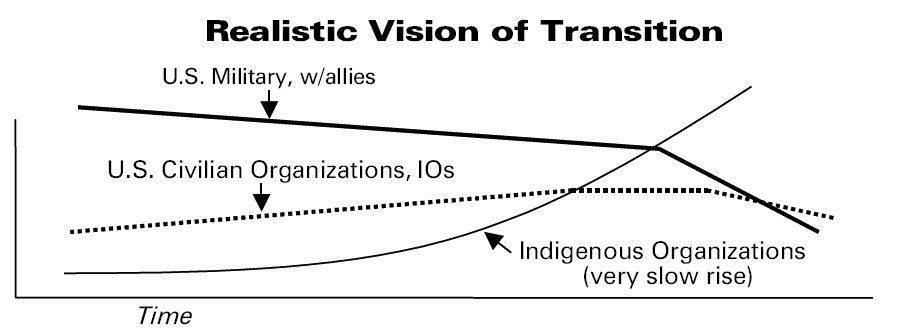
The US military - and the NATO armed forces as well - will in fact be asked to be able to if not formally manage then at least very substantially support whole conflict cycles. Or rather: They will be asked to deal extensively with the Phase IV things, as in Afghanistan, and not many civilian organizations will be there to help. Hence the PRTs.
But exactly this means that the military organizations should see an immediate self-centered interest in getting Shaping/CSE right. This not just conceptually, but also institutionally as an assured part of any two- or three-star's mindset. Shaping/CSE needs strategic attention. And a few bucks. But investing in systematic prevention planning and analysis capabilities will not be expensive.
Coming from a NATO country perspective the change in ambition for the Shaping/CSE JOC is therefore a disappointment. This kind of stuff will not emanate from NATO (SAC(T)). JFCOM needs to show intellectual leadership on this account. But, of course, I have no clue how the change played out - if there was involvement from elsewhere in the process once the scale of the ambition came clear.
And so, nonetheless, it will still be very interesting to the see the final text of the coming CS JOC.
It would be logical if Tom Barnett picked up on this, but he's busy writing the next book (and going to Springsteen concerts).
JFCOM: Shaping Ambition (Sort of) Implodes
The US Defense establishment does not want to do development any more. Or maybe a bit anyway. Those are the signals coming out from JFCOM concerning the - still - coming JOC on 'Shaping'.* Except for the the fact that it will no longer be called 'Shaping' but the much less ambitious 'Military Support to Cooperative Security'. In principle the ambition moves from managing fair statebuilding processes that actively helps popular inclusion into the state project (i.e. development) to security sector reform in various guises. That may be deplorable, as in a missed chance. As I wrote over a year ago:
The creation of African Command (AFRICOM) is accompanied by a the development of a new Joint Operating Concept (JOC) with potentially huge ramifications for the continent and for the whole development sector -- including the largest non-American partners, from the national development agencies (DfID, Danida, etc) over the EU and especially the UN to of course the 'host nations' in particularly Africa. This new JOC is called Shaping.The initial JFCOM ambitions for Shaping were described as:
Scope: This JOC will focus on the actions a joint force commander might take in the context of unified action to advance US interests by:My ensuing conclusion was:Proposed Solution: The Joint Force, as a part of a larger multinational and interagency effort, conducts continuous, anticipatory shaping operations that build partnerships with governmental, nongovernmental, regional and international organizations and reduce the drivers of conflict and instability in order to prevent or mitigate conflict or other crises and set the conditions for success in other operations—all aimed at a secure global environment favorable to US interests.
- building partnership capacity
- influencing non-partners and potential adversaries
- mitigating the underlying causes of conflict and extremism; and
- setting the conditions that enable rapid action when military intervention is required
How do you '[mitigate] the underlying causes of conflict and extremism', and 'mitigate conflict and other crises'? Well, this is exactly the work of the aggregate development organisations: from the UKs PCRU and USAID plus international NGOs like the ICG to more long-term development organisations like UNDP. Mitigating underlying causes of conflict means addressing grievances before they turn into rebellion ... it means strengthening the local state so that it delivers to its citizens: from basic infrastructure, a working, stable and sustainable economy that provides jobs, rule of law and a decent political system.And now, it seems, JFCOM has somewhat cold feet. Look at the JFCOM slide (ppt) below and then a quote from a testimony to the House Armed Services Committee (pdf) definition of the work on the Shaping (i.e. CS/CSE) JOC by Rear Admiral Dan Davenport:
The Pentagon will have their hands full -- and it is extremely important that they get the conceptual thinking right here. I hope the drafters will consult leading civilian development and political science experts and the extensive social science insights inside the CIA. (...)
On the civilian side, including the whole of the development universe: You better wake up and follow this development closely. The Pentagon has so much logistical and funding clout that if the Shaping concept does indeed get feet, then there will be some very real opportunities to move the development agenda forward.
As is visible the ambitions are curtailed a bit. Mostly, the military role will be either supporting or in the shape of defense reform.
- Draft Military Support to Cooperative Security, (CS JOC) focuses on how the Joint Force Commander contributes to fostering a security environment favorable to U.S. interests as well as establishing a base for effective crisis response. It addresses the full range of military support to a comprehensive, whole of government approach. “CS is defined as the set of continuous, long-term integrated, comprehensive actions among a broad spectrum of U.S. and international governmental and non-governmental partners that maintains or enhances stability, prevents or mitigates crises, and enables other operations when crises occur.”

Nevertheless, the notion of prevention and whole of government enabling still seems to smell a bit of converging the security and development agendas - so that the aggregate US foreign policy elements might get to play together in a kind of preventive COIN operation at the strategic level in given countries.
Managing the successful integration of the people into the state is the surest way to achieve stability. That is so because then the third element of the Clausewitzian trinity (state, people/nation, army) - the armed forces - will not be challenged from the inside but answer to a state that is legitimate because it deals with its citizens in a way that corresponds to their make up - in terms of both relative quantity (population mix) and quality (culture(s)).
The focus on interagency in the testimony is completely right. But I just hope that the NSPD44 does not become an excuse for not developing advanced strategic understanding of the anthropological and political scientific underpinnings of conflict prevention and state failure at the top of the US military. These insights are the most cost effective way for the US defense to deal with the conflicts that are not related to the big power and technological warfare paradigm, i.e. not least (for AFRICOM) in Africa.
NB! There's a follow up to this post, here.
________________
* = A JOC or Joint Operating Concept, is a kind of generalized Field Manual, a pure and joint doctrine. The hierarchy of the JFCOM concepts can be seen here. The former Shaping JOC is number 6 in the left column:

NB! There's a follow up to this post, here.
Wednesday, March 19, 2008
The New UK Security Strategy: Thin, Somewhat Timid
This strategy (...) sets out the guiding principles of our approach (Chapter Two); our assessment of the major security challenges and drivers of insecurity (Chapter Three); our responses to them (Chapter Four); and how we will work together in taking the strategy forward (Chapter Five).Content:
Chapter One: IntroductionIt was expected that the strategy would emphasize interagency capability. It does. The initiative is sound: in principle, this would enable the UK government to combine and converge the three D's - diplomacy, development and defense. As such this makes for more effective counterinsurgency - or statebuilding within conflict - campaigns. As development and security converges in and around failing states the most cost-effective form of development in the long run is contested statebuilding.
Chapter Two: Guiding principles
Chapter Three: Security challenges
Chapter Four: The United Kingdom’s response
Chapter Five: Working together
5.8 This National Security Strategy shows that the Government is committed to working with the whole of society, to build confidence in our core values, our shared approach, and our strong security capabilities. It sets out a new and clearer understanding of what security means and how we need to work together in an integrated and coherent national and international effort. That will enable us to work together to manage risks, harness the opportunities of globalisation, and achieve the single overarching national security objective set out at the beginning of this strategy: protecting the United Kingdom and its interests, enabling its people to go about their daily lives freely and with confidence, in a more secure, stable, just and prosperous world.The contextual process to the UK National Security Strategy involves a yearly report on progress on challenges and solutions. But the strategy does not - as I suggested should be the case in the previous post - contain inside its concomitant process a systematic role of overview for Parliament. Such a role is being merely being looked into:
5.7 We will publish an annual update on the challenges we face and progress on implementing this strategy. We will consult all Parties and the Parliamentary authorities about how Parliament can play a stronger role in overseeing the development and implementation of this strategy. We have recently concluded a consultation to consider the ways in which Parliament should be involved in decisions relating to the deployment of the Armed Forces into conflict.The process as envisaged is at least a credible wish list:
Priorities include:That is disappointing. Since the process is not yet formalized at the launch the ship risks being taken over by bureaucratic pirates of e.g. the Foreign Office. Consulting (viz. the 'joint Parliamentary National Security Committee') can mean anything and nothing. And neither that committee nor the 'national security forum' are really given any role that would constitute checks and/or balances. Who will bang together the heads of DfID, Foreign Office and Whitehall?
• consulting on a joint Parliamentary National Security Committee to help monitor the implementation and development of this strategy;
• strengthening the work of horizonscanning and forward planning;
• strengthening the capability to offer a strategic perspective on security priorities and improve connections between defence, development, foreign and domestic security strategies;
• creating a national security forum, including representatives from government, politics, academia and others, to discuss strategy and exchange ideas; and
• publishing the National Risk Register (as set out in Chapter Four) and an annual update on the security challenges facing the United Kingdom and progress on implementing the strategy.
Finally, the strategic vision itself seems pretty thin. Not much text compared to the number of themes.
UK's New NSS and NSC: Lessons for Scandinavia
This Wednesday the British Government will publish the UK’s first ever National Security Strategy. This is a big moment for Gordon Brown and comes with great expectations. Don’t be surprised if there is no Minister on the Today Programme discussing the strategy’s pros and cons on Wednesday morning - this will be Gordon Brown’s opportunity to kill lots of birds with one mighty strategic stone (so lets hope he does wait and announce it in Parliament).The National Security Council bit is the perhaps most interesting part. The process more than the actual documents all clearly the most inventive parts intended with the Dutch and Canadian security strategies and the French Defense White Paper. Process is here to be understood not only as a process of creation (of the document) but also a process of evaluation (of its priorities).Dignity and gravitas will ooze from every pore of the front bench as Brown steps up to the dispatch box and announces the strategy. MPs from all sides of the House will nod and mouth their agreement. In the gallery sketch writers will pen columns for Thursday’s newspapers about how important Parliament is. For a brief moment the Government will look in complete control of its destiny - polls will even show the Labour party jump ahead of the Conservatives.
Some British newspapers are already trailing the announcement. The Telegraph suggests that ‘a national security council will be created, staffed by senior politicians including, potentially, individuals from other parties, intelligence and military chiefs, and scientific experts.. and that Paddy Ashdown has been suggested as a possible leading opposition figure with the experience to be invited to serve alongside senior Government ministers’.
Together these things will make possible a more thoroughly democratic debate on what is essentially political choices in international security (the 'wars of choice' in Iraq and Afghanistan; global warming as strategic challenge; the Arctic, etc); and a more stringent political leadership in the executive - not by civil servants. In sum, they should enable governments more effectively to face the challenges of security in a globalized world, including operational challenges such as a the interagency challenge in COIN and SSTR.
The Scandinavian countries, with their development legacy and 'moral foreign policies', more than other countries must go down this road as they need strive to conceptually converge the morality and national interest of global politics. And, in Denmark's case especially, deal with Afghanistan as war-fighting and as development.
Saturday, March 01, 2008
Air Force Snubs Boeing, Shows Maturity
Republican Presidential hopeful Senator John McCain (R-Ariz.) was an early and fierce critic of Boeing's lease scheme. McCain, who is also a member of the Senate Armed Services Committee, suggested as recently as December that the current fleet might have a longer life than the Air Force claims.
For McCain the decision is a mixed blessing. He has taken on defense contractors in the U.S. Senate and was instrumental in ending Boeing's lock on the tanker business during investigatory hearings in 2003. "He's going to have to tout this right away as a thing he handled for the benefit of American taxpayers," says University of Virginia political science professor Larry Sabato. "The Democrats are going to jump all over this as an example of how he helped move jobs overseas." The decision also could hurt McCain in Washington, Oregon, Texas, and Kansas, all of which have a heavy Boeing presence.
That must really hurt at Boeing - first losing out to Lockheed on the JSF, then to Sikorsky and Lockheed on the new search-and-rescue helicopter, and then now, the tanker deal to Northrop/EADS.
But instead of feeling sorry for a private company (even covered in patriotic paint) this decision should be celebrated as an expression of the strength of American democracy - and the correlate soundness (in this case) of the resulting administrative system. It must have taken guts to choose what is essentially a European (technology) solution. Because now the USAF top brass has to listen to all the coming unverifiable squabble about 'longterm strategic security' as expressed through 'a sound national defense industry'.
Problem for that argument is: Tankers are not hitech. Low-end aerospace capabilities have become commoditized. That is why the civilian world has a thing called no-frills airlines which compete on shaving costs such as coffee and and roll rather than new engines or tail fin designs.
Even so: Following the Druyun scandal, in political terms, the only recommended way forward for USAF was to stick to a fair and open competition based on merit. Kudos for doing so.
Friday, February 29, 2008
Sarko in South Africa and Army Ads
Second, France's president Sarkozy elaborated in a speech in SA on his proposed change in France's African policy. France no longer wants to "be the gendarme of Africa". Notable is the introduction of a principle of transparency in French relations with African countries, which apparently also means a hitherto unknown democratization of France's foreign policy with regard to Africa (in bold):
Et je veux devant le Parlement d’Afrique du Sud faire quatre propositions. La première porte sur les accords de défense entre la France et les pays africains. Ils doivent refléter l’Afrique d’aujourd’hui, et non pas l’Afrique d’hier. Ils doivent reposer sur les intérêts stratégiques de la France et de ses partenaires africains. Je ne dis pas qu’il faille nécessairement faire tablerase et tout effacer d’un seul trait de plume. Mais je dis que la France souhaite engager des discussions avec tous les Etats africains concernés pour adapter les accords existants aux réalités du temps présent et en tenant le plus grand compte de la propre volonté des pays africains. La France sera ouverte au dialogue avec tous ceux qui souhaiteront nouer avec elle un nouveau partenariat en matière de sécurité.
Deuxième proposition, je vais refonder nos relations sur un principe qui n’existait pas et que j’imposerai, le principe de la transparence. La transparence, c’est la meilleure garantie pour des relations solides et durables, le meilleur antidote aux fantasmes et aux incompréhensions. Contrairement à la pratique passée, j’annonce au Parlement d’Afrique du Sud que tous les accords de défense entre la France et les pays africains seront intégralement publiés. J’associerai également étroitement le Parlement français aux grandes orientations de la politique de la France en Afrique.
Troisièmement, je propose que la présence militaire française en Afrique serve en priorité à aider l’Afrique à bâtir, comme elle en a l’ambition, son propre dispositif de sécurité collective. L’Union africaine souhaite disposer de forces en attente à l’horizon 2010 – 2012 ? Eh bien que cet objectif soit aussi celui de la France ! La France n’a pas vocation à maintenir indéfiniment des forces armées en Afrique, l’Afrique doit prendre en charge ses problèmes de sécurité. Que l’on me comprenne bien : il ne s’agit nullement d’un désengagement de la France en Afrique. C’est tout le contraire. Je souhaite que la France s’engage davantage au côté de l’Union Africaine, cher Thabo, pour construire le système de sécurité collective dont l’Afrique a besoin car la sécurité de l’Afrique c’est d’abord naturellement l’affaire des Africains.
Enfin, ma dernière proposition vise à faire de l’Europe un partenaire majeur de l’Afrique en matière de paix et de sécurité. C’est le sens du partenariat conclu entre nos deux continents à Lisbonne en décembre dernier. C’est notre intérêt à tous, car une Europe forte a besoin d’une Afrique forte. Mais je sais bien que le meilleur garant de la paix et de la sécurité, c’est la démocratie et la justice. Alors parlons-en de démocratie et de justice. La France souhaite en en Côte d’Ivoire la tenue d’élections libres, justes et reconnues. Aucun pays ne peut espérer le développement sans organiser des élections démocratiques.
Wednesday, February 27, 2008
State Department Memo on Iraq
I've been hearing a lot about this memo from various political appointees and senior bureaucrats recently, with everyone saying it would be a big deal when it hit the Net. Well, now it's here and while it is truly damning, to me it's just another nail in the coffin of the idea, promoted by the HELP Commission, that somehow a better or bigger State can handle this sort of operation in the future. Nothing could be further from the truth and this memo speaks to that reality. (...)This seems to be a widespread problem in all of the Western foreign offices. But the diplomats are not the ones who are operative, traditionally. That role befalls the state aid agencies (USAID etc): But does the DFIDs, DANIDAs and NORADs of the world accept that they are in war with the Taliban in Afghanistan?
The problem is, of course, that our State Department and U.S. foreign policy in general (meaning Bush and Cheney) are largely missing from the scene. Yes, lotsa trips and many talking points delivered, and certainly there's been a vast shuffling of paper in the Green Zone, but where is the diplomacy? The security space created by the Surge was designed to create a political space that remains unexploited and even largely unaddressed. Nowhere is this lack of effort more apparent than in the diplomatic trenches of our State Department presence on the ground in Iraq, which this memo addresses.Iraq and Afghanistan are transforming our military, with that transformation starting to penetrate the Pentagon itself. But no such transformation is brewing within the State Department, either on the ground or in Foggy Bottom. In the end, I don't expect one to ever brew inside State and, truth be told, I'm not sure one should brew, because I don't see the logic of trying to get this institution to add on such capacity in what will inevitably be a "lesser included" manner. It didn't work at Defense and it won't work at State, even as each department is a key player in this process.
We either create a legitimate bureaucratic center of gravity for such efforts, or we'll continue to underperform.
Regarding Iraq in particular, the memo comes at the same time as Global Guerilla's reflections on the Rosen article in Rolling Stone. Discomforting. For a 100 years?
New Army Field Manual - Implementing Iraq
...the manual has finally taken the step of elevating stabilization operations to the level of offensive and defensive ops. (...) Chapter 3 is the most important chapter in the book; describing the Army's operational concept -- full spectrum operations. Full spectrum operations seize, retain, and exploit the initiative through combinations of four elements: offense, defense, and stability or civil support operations. Mission command is the preferred method of exercising battle command.Basically, this is the practical implementation of the DoD Directive 3000.05 - and the result of necessities on the ground forcing top Army brass to accept the comprehensive or political COINesque approach to armed conflict championed by Petraeus and smart people at JFCOM.
Get the manual here at the Army site (direct link to pdf, 7,3 megs)
Speaking of JFCOM: Apparantly, a draft version of the Shaping JOC should be close to greenlighting mid March.
China Getting Involved in Darfur?
China might now be moving on Darfur - perhaps a sign that Spielberg's personal foreign policy is working?
China's envoy to Darfur has urged Sudan to accept the full deployment of a UN-African Union peacekeeping force. In a rare public rebuke to Khartoum, visiting envoy Liu Guijin said it should "co-operate better with the international community" on the force, according to a report by Chinese official news agency Xinhua. The force began deploying in January, but still lacks most of the 26,000 personnel planned for the mission - due in part to Sudanese objections concerning the international composition of the force. (...)
In his comments to Xinhua, Mr Liu said deploying the peacekeeping operation and resolving the Darfur issue required "the joint efforts of all sides. "First, the Sudan government should co-operate better with the international community and demonstrate greater flexibility on some technical issues. Next, anti-government organisations in the Darfur region should return to the negotiating table."
China has long had strong trade and military links with Khartoum, which is accused of backing militias that have raped and murdered civilians in Darfur - accusations it denies. But Beijing is keen to show it is playing a positive role in the region, says the BBC's Amber Henshaw in Khartoum. Mr Liu said Sudan only bought 8% of its weapons from China and said if China stopped selling weapons, they could easily be purchased from other countries.

Replacing the F16 - Norwegian Television
Eurofighter left the three-way competition just before christmas, apparently convinced that they were not getting a fair deal (or that they did not have a competitive product). This leaves the JSF and the Gripen in the running for the largest defence aquisitions ever in Danish and Norwegian history.
About the program
See the program

Tuesday, February 26, 2008
AFRICOM again
Dracobs has been covering Africom of course from the early start - so check out the earlier posts, including those that project the Shaping JOC to be of central relevance for Africom. Shaping aims to do conflict prevention in the shape of grievance settlement, meaning that Pentagon has to do real political development policy.I attended USC's AFRICOM conference earlier this month and between panel discussions and offline conversations, I came away with a new appreciation (and hope) for the newest, and very different, command.
This is not like the other Combatant Commands (one DOD representative said they dropped "Combatant" from the title, but depending on where you look, all commands have that word or none of the commands include that adjective).
Also unlike other commands, this is "focused on prevention and not containment or fighting wars." This is, as one speaker continued, is a "risk-laden experiment" that is like an Ironman with multidisciplinary requirements and always different demands [...]. The goal, he continued, was to "keep combat troops off the continent for 50 years" because the consensus was, once troops landed on Africa, it would be extremely difficult to take them off.
Monday, February 25, 2008
TicTacs #8: Como decimos ayer
- McCain elaborates on the 100-year remark on Iraq. You have to admire his frankness - even though I'd think the base issue has not been bilateraly resolved.
- Danish aerospace expert Karsten Marrup reads into the shooting down of the satellite over the Pacific a wish to demonstrate that the missile defense does actually work. Danish centre-left daily Politiken.
- The air tanker deal is nearing an end according to the Seattle Post-Intelligencer. Same story from AFP. Last time around Darleen Druyun got a bit too personally involved in the process, but thanks to people including McCain the scandal broke. According to the Economist the Airbus KC30 is the more capable aircraft - but common sense dictates the American domestic choice.
- A host of new CRS reports from FAS Secrecy News by the indomitable Stephen Aftergood, including "Instances of Use of United States Armed Forces Abroad, 1798-2007," updated January 14, 2008 - oh, and the cost of the GWOT.
Tuesday, July 17, 2007
Tuesday, July 10, 2007
Civilian SSTR Planning: NSC or Private Sector Lead
This blog often takes an American perspective - or looks primarily at American developments. This is because US leadership is paramount. Whatever happens elsewhere is likely to be to small to be consequential or effective. But this doesn't mean that other countries - notably the UK or e.g. Denmark - could not in theory either develop interesting concepts or organizational innovations which might either be of use or inspiration to the US institutions (as in e.g. the PCRU).
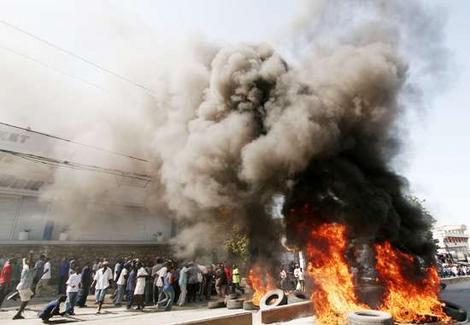 Establishing better integrated military-civilian planning is the only way to construct a strategically realistic "total cost of life" approach to future interventions. Such an approach should make clear e.g. the need for civilian (local or external) police forces. Of course, the Dobbins Handbook gives hints but we need more concrete planning.
Evidently, the Pentagon is not going to open their warplanning to civilians - not even the NSC. But it would be helpful if the civilian side could at least know that the Pentagon planning process had or will be reformed in accordance with the DoD Directive 3000.05 (the problem is here that the NSPD 44 formally gives State the lead, and the S/CRS does not have resources even remotely comparable to OSD, Pentagon itself or even JFCOM.
Of course, some of this planning stuff could be produced or at least introduced in generic form by the private and international public sector - here preferably the non-profit side - like e.g. a combination of UN people (from the UNDP plus the Peace-building Commission) and relevant think-tankers like the Dobbins people, and maybe concerted or hosted by the ICG. But in purely US terms, the NSC could play such a role.
The NSC seems to be the only place where funds can be found for this kind of exercise (given substantive executive interest, i.e. will not happen until the next administration). But this means that now would be a good time to spread such and idea in order for it to be somewhere on the upcoming administrations' agendas. Richard Clarke's great "Against All Enemies" explains and exemplifies how an adept operator can help create leeway for interagency policy development inside the NSC. In fact, as he mentions explicitly, he was part of the process for creating POL-MIL plans starting with Haiti. So the nuts and bolts and precedence are there. As always it is more a matter of political will and focus than anything else.
Tuesday, July 03, 2007
Scandinavia: Weber Incarnate (Plus Bacon)
 Cartoon courtesy of wulffmorgenthaler.com.
Suskind's One Percent Doctrine
This is not a review, just a recommendation (hereby given) - plus a few general observations:
- Suskind writes well, very well even. Once in a while even too well when his asides on the general character of modern politics become to fluffy, even if they're generally illuminating.
- The book underscores the most important lesson one can learn about politics: It is about ideas that are put to work. Not everyone can do grand strategy, but every (political) organization should prize and protect the people they have that will question the assumptions - doxa in Bourdieu's sense - that we take for granted.
- Explicitness and formalization of the policy process are paramount. It doesn't have to be difficult: hear out the stakeholders and experts, then make a choice. Cherry picking reality is ... evidently idiotic.
- Even if the GWOT (or the Long war) may be in bad standing in European press and public, nobody can or should close their eyes to the basic challenge that Cheney tries/tried to solve with the one percent doctrine. We cannot allow a nuke to go off in our cities - or elsewhere for that matter. As Blair so emphatically stated in his farewell op/ed in the Economist it is not going to go away - we have to fight this struggle.
Monday, July 02, 2007
GAO Report Confirms Civil Planning Need
DOD has taken several steps to improve planning for stability operations, but faces challenges in developing capabilities and measures of effectiveness, integrating the contributions of non-DOD agencies into military contingency plans, and incorporating lessons learned into future plans. These challenges may hinder DOD’s ability to develop sound plans. Since November 2005, the department issued a new policy, expanded its military planning guidance, and defined a joint operating concept to help guide DOD planning for the next 15–20 years. These steps reflect a fundamental shift in DOD’s policy because they elevate stability operations as a core mission comparable to combat operations and emphasize that military and civilian efforts must be integrated. However, DOD has yet to identify and prioritize the full range of capabilities needed for stability operations because DOD has not provided clear guidance on how and when to accomplish this task. As a result, the services are pursuing initiatives to address capability shortfalls that may not reflect the comprehensive set of capabilities that will be needed by combatant commanders to effectively accomplish stability operations in the future. Similarly, DOD has made limited progress in developing measures of effectiveness because of weaknesses in DOD’s guidance.The report then confirms what I have said before (in "The Most Unsexy Headline Ever: Planning Capabilities in the Inter-Agency Process"): We need civil planning - or at least: planning for the civilian side of contingency plans. And nobody - including internationally - has the knowhow and the resources to do it but Pentagon.
DOD is taking steps to develop more comprehensive military plans related to stability operations, but it has not established adequate mechanisms to facilitate and encourage interagency participation in its planning efforts. At the combatant commands, DOD has established working groups with representatives from several key organizations, but these groups and other outreach efforts by the commanders have had limited effect. Three factors cause this limited and inconsistent interagency participation in DOD’s planning process: (1) DOD has not provided specific guidance to commanders on how to integrate planning with non-DOD organizations, (2) DOD practices inhibit sharing of planning information, and (3) DOD and non-DOD organizations lack a full understanding of each other's planning processes, and non-DOD organizations have had a limited capacity to participate in DOD's full range of planning activities.
Although DOD collects lessons learned from past operations, planners are not consistently using this information as they develop future contingency plans. At all levels within the department, GAO found that information from current and past operations are being captured and incorporated into various databases. However, planners are not consistently using this information because (1) DOD’s guidance for incorporating lessons into its plans is outdated and does not specifically require planners to take this step, (2) accessing lessons-learned databases is cumbersome, and (3) the review process does not evaluate the extent to which lessons learned are incorporated into specific plans.
Wednesday, June 27, 2007
My Bad Conscience: International Security's Most Downloaded Articles
Not only do you discover things you didn't read. You also see that things you saw in the TOC and thought "nah, doesn't matter, no time" and now its here, being downloaded and the market always tells the truth, eh, so maybe you should read it anyway?This list is updated each day based on the volume of full text downloads.
Track Citation for selected articles

1.
2.
3.
4.
5.
6.
7.
8.
9.
10.
11.
12.

13.
14.
15.
16.
17.
18.
19.
20.
Either that, or the list is just an expression of what's free and what's not. All of the Top 12 articles are free: the first paying article is Thomas J. Christensen's "Fostering Stability or Creating a Monster? The Rise of China and U.S. Policy toward East Asia", who then wins the contest for being most attractive in spite of the cost.
The great thing about the list is the daily update. Now, you kinda see in the spirit how several of the authors will click in every day to follow their stock in the trade, nervously tracking their fortunes on the waves of academia.
That of course leaves open all kinds of ridiculous possibilities, like repeats of the record promoting business where promotors would buy endless stacks of records to get their singles high enough on the charts to get them airtime and make that generate some real sales... Will a Professor be tempted to pull several thousand downloads through his students? Can you make money with a company that will enable academics to buy enhanced visibility through automated and timed downloads?